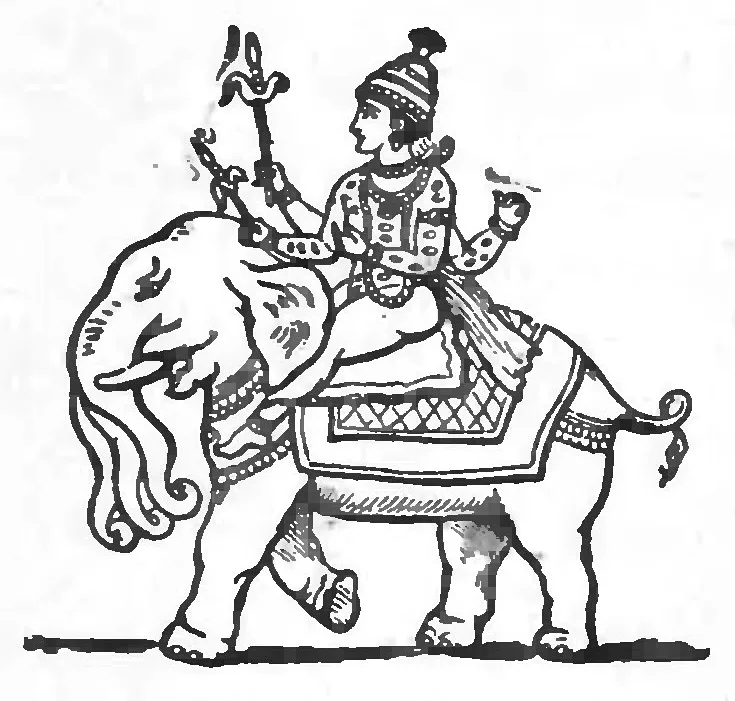
Indra
King of the devas; most-invoked Vedic deity, with roughly 250 Ṛgvedic hymns addressed to him — more than any other figure. Slayer of the dragon Vṛtra (Ṛgveda 1.32), releaser of the cosmic waters. Wielder of the vajra. Father of Arjuna in the Mahabharata; in Vana Parva 308 disguises himself as a brahmin to extract Karṇa's divine armor (kavacha) and earrings (kuṇḍala) to protect Arjuna — a structurally critical and morally fraught episode that sets up the Kurukshetra denouement.
Parentage
Recorded default; alternative parentage accounts are listed separately below.
No parents recorded in the default.
Parentage accounts
Each account is a separate source claim. The parentage and children listed outside these accounts use the recorded default. Selecting an account in the interactive app updates its lineage, descent classification and inherited-power candidates. Linked pedigree accounts are selected together; other records retain their recorded parentage. Claims of ancestry are not proof of biological descent or attested powers.
- Viṣṇu Purāṇa 1.15: Aditi and Kaśyapa
deity by descent in this account.
- mother: AditiViṣṇu Purāṇa 1.15, Wilson translation, Āditya genealogy (primary)
- father: KashyapaViṣṇu Purāṇa 1.15, Wilson translation, Āditya genealogy (primary)
- Atharvaveda 3.10: Ekāṣṭakā (father not named)
deity by descent in this account.
- mother: EkāṣṭakāAtharvaveda 3.10.12–13, Griffith translation (primary)
Children
Names and tradition associations
- Śakra G. P. Malalasekera, Dictionary of Pāli Proper Names, s.v. Sakka, sections on family, epithets, office and Indra (secondary)
- Indra (Iranian daeva) William W. Malandra, “Indra,” Encyclopaedia Iranica XIII/1 (2004), pp.103–105, Iranian tradition and concluding paragraphs (secondary)
Variant accounts
- Birth and unnamed parentsṚgveda 4.18 describes an unusual birth and conflict with a father; the reviewed translation does not securely identify either parent. This narrative is not merged with the Purāṇic genealogy.Ṛgveda 4.18.1–13, Griffith translation (primary)
- source review correctionReplace unconditional equivalence with the source-bounded relationship status.G. P. Malalasekera, Dictionary of Pāli Proper Names, s.v. Sakka, sections on family, epithets, office and Indra (secondary)
- source review correctionQualify both endpoints consistently with the reviewed Burmese evidence.Northern Illinois University, The Pagan Period, Shwezigon stupa and nat shrine (secondary)
- source review correctionQualify the existing equation using the reviewed regional comparison.Michael Witzel, Kalash Religion, extract from The Ṛgvedic Religious System (2004), §§1.5.1–1.5.3, pp.3–8 and n.4 (secondary)
Domains
- kingship of devas
- thunder rain storms
- war and heroic strength
Powers
- Grants boons and divine weapons
- Hurls the thunderbolt to slay foes
- Sends rain and storms
- Changes shape and disguises himself
Epithets
- शक्र The Mighty One; king of the devasṚgveda, passim; Mahābhārata (primary)
- वृत्रहन् Slayer of the dragon VṛtraṚgveda 1.32 (the Vṛtra-slaying hymn) (primary)
- देवेन्द्र Lord/king of the godsMahābhārata; Purāṇic tradition (primary)
- पुरन्दर Destroyer of (enemy) strongholdsṚgveda 1.102.7; 3.54.15 (primary)
- मघवन् The Bountiful, the liberal giverṚgveda, passim (frequent Indra epithet) (primary)
- वज्रिन् Wielder of the vajra (the thunderbolt)Ṛgveda 1.32.2 (the slaying of Vṛtra) (primary)
- गोत्रभिद् Cleaver of the cow-pens; releaser of the imprisoned cattle and watersṚgveda 6.17.1; 10.103 (primary)
- सहस्राक्ष The thousand-eyedMahābhārata; later Purāṇic tradition (primary)
Relations
- lover: KuntīInvoked by Kuntī using Durvāsā's mantra; fathered Arjuna. Indra later disguises himself as a brahmin to extract Karṇa's kavacha and kuṇḍala (Vana Parva 308) to protect his son Arjuna — the most morally complicated Indra act in the epic.Mahabharata, Adi Parva 122-123 (primary)
- father of: ArjunaMahabharata, Adi Parva 123 (primary)
- buddhist adaptation: ŚakraRelated divine conceptions; the Buddhist family is not the Hindu genealogy.G. P. Malalasekera, Dictionary of Pāli Proper Names, s.v. Sakka, sections on family, epithets, office and Indra (secondary)
- buddhist adaptation: ThagyaminBurmese Indra–Sakka–Thagyamin in the Shwezigon account; regional adaptation does not transfer family or attributes.Northern Illinois University, The Pagan Period, Shwezigon stupa and nat shrine (secondary)
- comparative identification: IndrRegional comparison; biographies remain distinct.Michael Witzel, Kalash Religion, extract from The Ṛgvedic Religious System (2004), §§1.5.1–1.5.3, pp.3–8 and n.4 (secondary)
- spouse: ŚacīBhāgavata Purāṇa 6.18.7, Sanskrit and translation (primary)
- father of: JayantaBhāgavata Purāṇa 6.18.7, Sanskrit and translation (primary)
- father of: Ṛṣabha son of IndraBhāgavata Purāṇa 6.18.7, Sanskrit and translation (primary)
- father of: MīḍhuṣaBhāgavata Purāṇa 6.18.7, Sanskrit and translation (primary)
- acknowledged father: RājiAcknowledgement following aid in war; not biological parentage.W. J. Wilkins, Hindu Mythology, Vedic and Puranic, chapter VII, pp. 61–62 (secondary)
- sibling: VishnuViṣṇu Purāṇa 1.15 Āditya birth account; no universal genealogy inferred.Viṣṇu Purāṇa 1.15, Wilson translation, Āditya genealogy (primary)
- sibling: AryamanViṣṇu Purāṇa 1.15 Āditya birth account; no universal genealogy inferred.Viṣṇu Purāṇa 1.15, Wilson translation, Āditya genealogy (primary)
- sibling: DhutiViṣṇu Purāṇa 1.15 Āditya birth account; no universal genealogy inferred.Viṣṇu Purāṇa 1.15, Wilson translation, Āditya genealogy (primary)
- sibling: TvashtrViṣṇu Purāṇa 1.15 Āditya birth account; no universal genealogy inferred.Viṣṇu Purāṇa 1.15, Wilson translation, Āditya genealogy (primary)
- sibling: PushanViṣṇu Purāṇa 1.15 Āditya birth account; no universal genealogy inferred.Viṣṇu Purāṇa 1.15, Wilson translation, Āditya genealogy (primary)
- sibling: SūryaViṣṇu Purāṇa 1.15 Āditya birth account; no universal genealogy inferred.Viṣṇu Purāṇa 1.15, Wilson translation, Āditya genealogy (primary)
- sibling: Savitri, the ĀdityaViṣṇu Purāṇa 1.15 Āditya birth account; no universal genealogy inferred.Viṣṇu Purāṇa 1.15, Wilson translation, Āditya genealogy (primary)
- sibling: MitraViṣṇu Purāṇa 1.15 Āditya birth account; no universal genealogy inferred.Viṣṇu Purāṇa 1.15, Wilson translation, Āditya genealogy (primary)
- sibling: VarunaViṣṇu Purāṇa 1.15 Āditya birth account; no universal genealogy inferred.Viṣṇu Purāṇa 1.15, Wilson translation, Āditya genealogy (primary)
- sibling: AmshaViṣṇu Purāṇa 1.15 Āditya birth account; no universal genealogy inferred.Viṣṇu Purāṇa 1.15, Wilson translation, Āditya genealogy (primary)
- sibling: BhagaViṣṇu Purāṇa 1.15 Āditya birth account; no universal genealogy inferred.Viṣṇu Purāṇa 1.15, Wilson translation, Āditya genealogy (primary)
- father of: Jayantī, daughter of IndraPurāṇa Index, Jayantī 1c, citing Brahmāṇḍa III.72.150,156; III.73.3 and Matsya 47.114–188 (secondary)
- companion: MarutsViṣṇu Purāṇa 1.21.30–41, McComas Taylor translation (2021) (primary)
- name comparison: Indra (the daeva)Shared name; historical development is disputed.William W. Malandra, “Indra,” Encyclopaedia Iranica XIII/1 (2004), pp.103–105, Iranian tradition and concluding paragraphs (secondary)