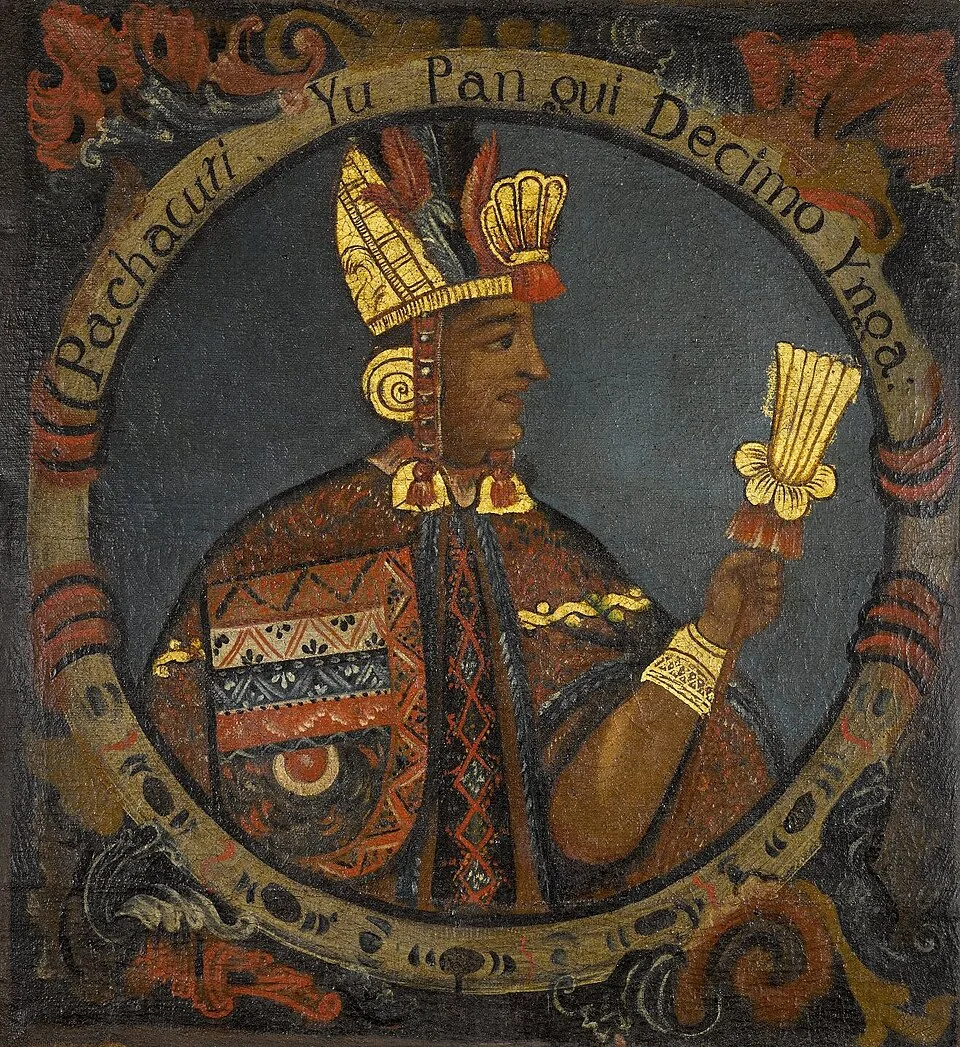
Pachacuti
Ninth Sapa Inca and founder of the Inca empire. The pivot-figure between legendary-historical pre-imperial dynasty (Manco Cápac through Viracocha Inca, c. 1200-1438, conventionally dated but archaeologically thin) and verifiable imperial history (1438-1572, archaeologically and architecturally substantial). The 1438 defense of Cuzco against the Chanka invasion is the foundational event: Cusi Yupanqui's solitary defense, the panaca acclamation displacing his fugitive father Viracocha Inca and his fugitive elder brother Inca Urco, and the regnal-name adoption Pachakuti Yupanki ("World-Overturner Honored One") inaugurated the imperial era. His c. 1438-1471 reign produced the foundational architectural, administrative, and ritual framework of Tahuantinsuyu: the rebuilt cut-stone Coricancha, the formal panaca system, the ceque ritual-geographic sight-line system, the mit'a labor-rotation tax, the qhapaq ñan imperial road network, the imperial quipu accounting bureaucracy, and probably the royal-estate construction of Machu Picchu, Pisaq, and Ollantaytambo. His son Túpac Inka Yupanki extended the empire to Quito in the north and the Maule River in central Chile; his grandson Huayna Cápac brought the empire to its maximum extent before the smallpox epidemic of c. 1525-1527 and the Atahualpa-Huascar civil war that preceded the Spanish conquest of 1532. Scion-class by registry math (the cumulative dilution from Inti through eight intervening generations places f below the deity-band threshold), but his genealogical position as the empire-founder and the cosmic-pivot regnal name make him the conceptual apex of the Inca dynastic registry. The Pachakuti term itself entered Andean conceptual vocabulary permanently: the Spanish conquest of 1532 was named the second Pachakuti by post-Conquest indigenous tradition (preserved in the Q'ero/Quechua Inkarri narrative), and the eventual Inkarri reconstitution is named as the third Pachakuti — Pachacuti the man becomes the eponym for cosmic-pivot events in the entire Andean-temporal framework.
Parentage
- paternal: Viracocha Inca
- parent: Mama Runtu
Children
Powers
- Received a vision of the creator/Sun before the Chanca war
- Stones rose as warriors to fight at his side
Relations
- half sibling: Inca Urco
- spouse: Mama Anahuarque
- spouse: Mama Anahuarque, of the Choco lineage; principal Coya; mother of Túpac Inka Yupanki and Amaru Túpac · IncaSarmiento Ch. 47 (primary)
- father of: Túpac Inka Yupanki, tenth Sapa Inca (r. c. 1471-1493), continuator of imperial expansion to Quito and the Maule River in central Chile · IncaSarmiento Ch. 47-48 (primary)
Sources
- existence: Sarmiento de Gamboa, Historia Índica (1572) Ch. 24-47 (primary); Betanzos, Suma y Narración (1551) Pt. I Ch. 6-32 (primary); Cieza de León, Crónica del Perú Pt. II Ch. 44-58 (primary); Garcilaso de la Vega, Comentarios Reales Bk. V-VI (primary); Cobo, Historia del Nuevo Mundo Bk. XII Ch. 12-14 (primary); Guaman Poma, Nueva Corónica c. 1615 (primary); imperial Cuzco architectural fabric c. 1438-1471; Coricancha cut-stone masonry; Sacsayhuamán; Pisaq, Ollantaytambo, Machu Picchu Sacred Valley estates (archaeological)
- imperial-state-formation: Rostworowski, Historia del Tahuantinsuyu (1988); Rowe, "An Introduction to the Archaeology of Cuzco" (1944); D'Altroy, The Incas (2002); Julien, Reading Inca History (2000) (secondary)