Māui-tikitiki-a-Taranga
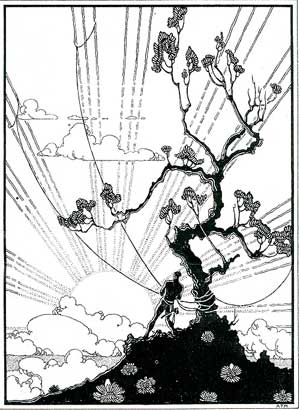
Pan-Polynesian culture-hero and trickster, demigod son of the underworld-atua Makeatutara by the mortal rangatira Taranga in the dominant Maori tradition. Born prematurely; abandoned in the sea wrapped in his mother's topknot (tikitiki — hence Māui-tikitiki-a-Taranga); rescued by ocean spirits; raised in the sky by the divine ancestor Tama-nui-ki-te-rangi. Returned to his mortal mother's village; recognized by Taranga only after reciting his four mortal brothers' names. Followed Taranga to the underworld in the form of a kererū (wood pigeon) and discovered his father Makeatutara — but Makeatutara rushed the baptismal tohi incantations and forgot parts, condemning Māui and through him all humanity to mortality. Cultural feats: fished up Te Ika-a-Māui (the North Island of New Zealand) using a magical fish-hook made from his grandmother Murirangawhenua's jaw-bone; snared the sun (Tama-nui-te-rā) with ropes from his sister's hair and beat it with the jaw-bone until it agreed to move more slowly across the sky, lengthening daylight; brought fire to humanity from Mahuika the atua of fire by tricking her into giving up her burning fingernails one by one, then preserving the last spark in the māhoe and kaikōmako trees. Final attempt at winning immortality: entered Hine-nui-te-pō (the goddess of death and underworld) in the form of a worm intending to crawl through her vagina to her mouth and reverse mortality; the fantail bird (pīwakawaka) laughed at the sight, woke Hine-nui-te-pō, and Māui was crushed between her obsidian and pounamu vaginal teeth — fulfilling Makeatutara's baptismal-error prophecy. The hei-matau (stylized fish-hook pendant of bone or pounamu / greenstone) is among the most iconic Maori taonga and a continuing modern cultural symbol. The Te Ara — Encyclopedia of New Zealand explicitly classifies him as demigod. Pan-Polynesian variants in Hawaiian (Māui-a-Kalana), Tahitian, Tongan, Samoan, Mangarevan, Marquesan, and Cook Islands traditions preserve related figures with varying parental configurations recorded in `variants[]`.
Parentage
- paternal: Makeatutara
- maternal: Taranga
Names and tradition associations
Variant accounts
- paternity-by-Tangaroa-instead-of-Makeatutara
- Hawaiian-paternity-by-Akalana
- Mangarevan-eight-Maui-brothers
Domains
- culture hero trickster
- fisher of Aotearoa and shaper of Polynesian geography
Powers
- superhuman strength
- Fishes up islands from the sea
- Wields ancestral mana through incantation
- Transforms into birds and creatures
- Snares and beats the sun to slow it
- Wrests fire from the fire-goddess
Epithets
- Māui-tikitiki-a-Taranga Māui formed in the topknot of Taranga; the demigod’s full nameGeorge Grey, Polynesian Mythology (Nga Mahi a nga Tupuna) (secondary)
- Māui-pōtiki Māui the last-born; youngest of the five Māui brothersGeorge Grey, Polynesian Mythology (secondary)
Relations
- sibling: Maui-taha (one of the four elder Maui-brothers per the Maori "Five Maui" tradition) · PolynesianMāui-taha ("Māui-to-the-side") — mortal full brother. Entry pending if needed.Maori oral tradition (primary)
- sibling: Maui-roto (one of the four elder Maui-brothers per the Maori "Five Maui" tradition) · PolynesianMāui-roto ("Māui-within") — mortal full brother. Entry pending if needed.Maori oral tradition (primary)
- sibling: Maui-pae (one of the four elder Maui-brothers per the Maori "Five Maui" tradition) · PolynesianMāui-pae ("Māui-opposite") — mortal full brother. Entry pending if needed.Maori oral tradition (primary)
- sibling: Maui-waho (one of the four elder Maui-brothers per the Maori "Five Maui" tradition) · PolynesianMāui-waho ("Māui-without") — mortal full brother. Entry pending if needed.Maori oral tradition (primary)
- foster parent: Tama-nui-ki-te-rangi (Polynesian celestial-foster-figure who raised Maui in some traditions; not registered as standalone entry per the registry's deity-only-as-required-parent-anchor principle) · PolynesianMaori oral tradition (primary)
- spouse: Rohe (sister-and-wife of Maui-tikitiki in some Maori traditions, dies at his hand and becomes the spirit of the underworld) · PolynesianRohe entry pending. Wife in a rare Maori variant; Māui mistreated her by swapping faces with her against her will out of jealousy of her greater beauty.Rare Maori variant tradition; Tregear 1891 (primary)
- spouse: Hina-ke-aloha-ila (Hawaiian wife of Māui, mother of his children) · PolynesianHinakealohaila entry pending — Hawaiian wife of Māui-a-Kalana.Hawaiian tradition (primary)
- equated with: MāuiReflex of the same ancestral Polynesian deity (*Māui), cognate across the island groups.Comparative Polynesian mythology: reflexes of the same ancestral deity across the island groups (E. Tregear, Maori-Polynesian Comparative Dictionary, 1891; R. D. Craig, Dictionary of Polynesian Mythology, 1989) (secondary)
- equated with: MauiReflex of the same ancestral Polynesian deity (*Māui), cognate across the island groups.Comparative Polynesian mythology: reflexes of the same ancestral deity across the island groups (E. Tregear, Maori-Polynesian Comparative Dictionary, 1891; R. D. Craig, Dictionary of Polynesian Mythology, 1989) (secondary)
- equated with: Maui-tikitikiReflex of the same ancestral Polynesian deity (*Māui), cognate across the island groups.Comparative Polynesian mythology: reflexes of the same ancestral deity across the island groups (E. Tregear, Maori-Polynesian Comparative Dictionary, 1891; R. D. Craig, Dictionary of Polynesian Mythology, 1989) (secondary)
- equated with: MahuiReflex of the same ancestral Polynesian deity (*Māui), cognate across the island groups.Comparative Polynesian mythology: reflexes of the same ancestral deity across the island groups (E. Tregear, Maori-Polynesian Comparative Dictionary, 1891; R. D. Craig, Dictionary of Polynesian Mythology, 1989) (secondary)
- equated with: Maui KisikisiReflex of the same ancestral Polynesian deity (*Māui), cognate across the island groups.Comparative Polynesian mythology: reflexes of the same ancestral deity across the island groups (E. Tregear, Maori-Polynesian Comparative Dictionary, 1891; R. D. Craig, Dictionary of Polynesian Mythology, 1989) (secondary)
- sibling: Māui-paeReciprocal of polynesian_maui_pae.sibling (alphabetical family sweep). (auto reciprocal)
- sibling: Māui-rotoReciprocal of polynesian_maui_roto.sibling (alphabetical family sweep). (auto reciprocal)
- sibling: Māui-tahaReciprocal of polynesian_maui_taha.sibling (alphabetical family sweep). (auto reciprocal)
- sibling: Māui-wahoReciprocal of polynesian_maui_waho.sibling (alphabetical family sweep). (auto reciprocal)
- spouse: RoheReciprocal of polynesian_rohe.spouse (alphabetical family sweep). (auto reciprocal)
Sources
- existence: Maori oral tradition (multiple iwi-specific variants); George Grey, Polynesian Mythology (1855); John White, The Ancient History of the Maori (1887-1890); Edward Tregear, Maori-Polynesian Comparative Dictionary (1891); Te Ara — The Encyclopedia of New Zealand; Beckwith, Hawaiian Mythology (1940 — for the Hawaiian Māui-a-Kalana parallel); Fornander, An Account of the Polynesian Race (1878-1885) (primary)
- parentage: Maori oral tradition (Makeatutara + Taranga as dominant); Te Ara — The Encyclopedia of New Zealand explicitly classifies as demigod (primary)