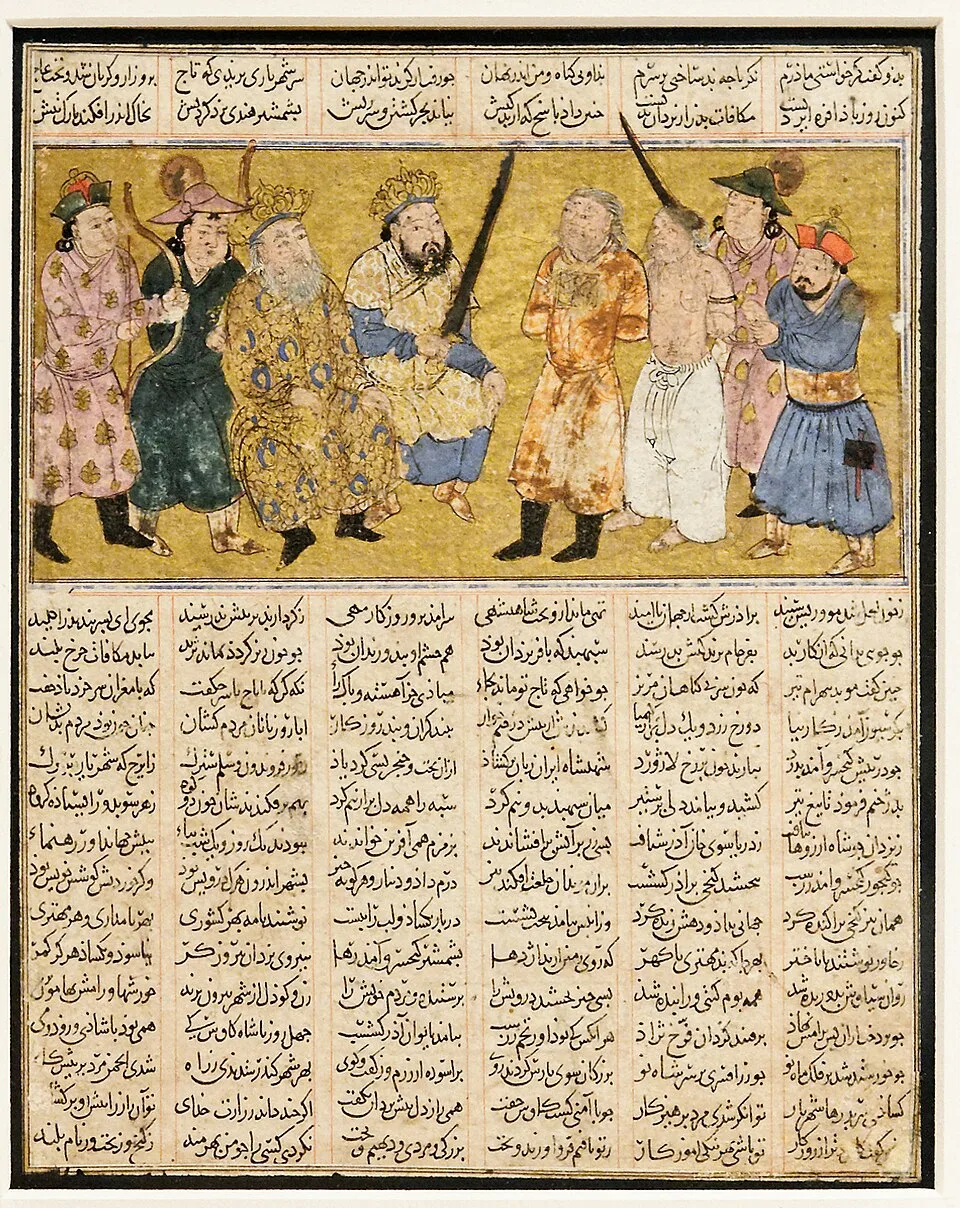
Kay Khusraw
Kay Khusraw is the model of the righteous sacral king in the Iranian tradition shared by the Tajiks, and the son of the martyred prince Siyovush. Born in Turan to the princess Farangis and smuggled back to Iran, he grows to avenge his father by overthrowing Afrasiyab, and reigns as the very embodiment of justice, endowed with the farr, the divine glory of kingship. At the summit of his power, weary of the world, he sets his affairs in order and rides into the mountains with his companions, where he vanishes into snow and is seen no more, a departure that later Zoroastrian tradition reworks into his awaited return at the end of time. He continues the Avestan hero Kavi Haosravah, binding the living Tajik epic imagination to the deepest layer of the Iranian past.
Parentage
- parent: SiyovushSon of the murdered Siyovush, born and raised in Turan before returning to claim the Iranian throne.Firdawsi, Abu'l-Qasim. Shahnama (The Book of Kings). Trans. Dick Davis. New York: Penguin, 2006. (primary)
Domains
- sacral kingship
- justice vengeance
Powers
- possess the divine royal fortune
Epithets
- Кайхусрав — of Good RenownYarshater, Ehsan. 'Iranian National History.' In The Cambridge History of Iran, vol. 3(1), 359-477. Cambridge: Cambridge University Press, 1983. (secondary)
Relations
- parent: SiyovushSon of the murdered Siyovush, born and raised in Turan before returning to claim the Iranian throne.Firdawsi, Abu'l-Qasim. Shahnama (The Book of Kings). Trans. Dick Davis. New York: Penguin, 2006. (primary)
- ally: RustamServed by the champion Rustam in the war of vengeance against Afrasiyab.Firdawsi, Abu'l-Qasim. Shahnama (The Book of Kings). Trans. Dick Davis. New York: Penguin, 2006. (primary)
Sources
- Kay Khusraw is the ideal just king of the Kayanian dynasty, son of Siyovush, who avenges his father and mysteriously disappears from the world.: Firdawsi, Abu'l-Qasim. Shahnama (The Book of Kings). Trans. Dick Davis. New York: Penguin, 2006. (primary)
- He continues the Avestan Kavi Haosravah and carries the sacral royal glory (farr) in the Iranian national tradition inherited by the Tajiks.: Yarshater, Ehsan. 'Iranian National History.' In The Cambridge History of Iran, vol. 3(1), 359-477. Cambridge: Cambridge University Press, 1983. (secondary)