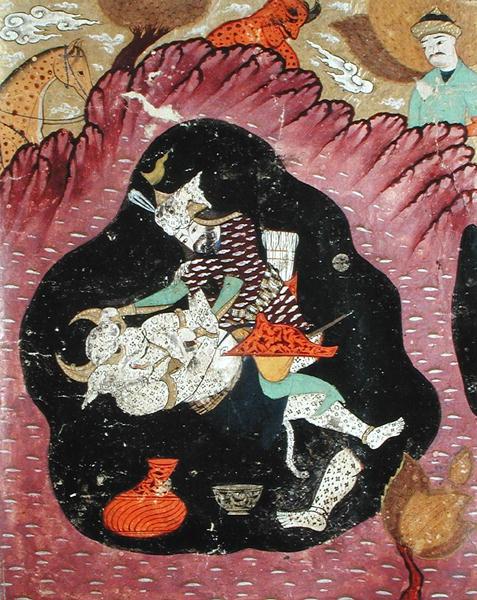
Rustam
Tajik · mortal · Tajik traditional religion; continuing · Recorded classification
Rustam is the supreme champion of the Iranian heroic tradition and a living presence in Tajik oral and literary culture. Sprung from the line of Sistan and mounted on the incomparable horse Rakhsh, he passes through the Seven Trials, slays the White Demon of Mazandaran, and serves the Kayanian kings across generations, unknowingly killing his own son Sohrab in the epic's most tragic episode. In the Tajik world his exploits are transmitted through Firdawsi's Shahnama, recited and sung, and through folk retellings that stand beside the indigenous Central Asian oral epic of Gurughli. He is a mortal hero of gigantic stature rather than a god, but his legend forms a core strand of the mythic imagination the Tajiks share.
Domains
- heroism championship
Powers
- overpower demons and armies single-handed
Epithets
- Таҳамтан — the Mighty-BodiedFirdawsi, Abu'l-Qasim. Shahnama (The Book of Kings). Trans. Dick Davis. New York: Penguin, 2006. (primary)
- Паҳлавон — the ChampionYarshater, Ehsan. 'Iranian National History.' In The Cambridge History of Iran, vol. 3(1), 359-477. Cambridge: Cambridge University Press, 1983. (secondary)
Relations
- ally: SiyovushFoster-father and arms-tutor of the young Siyovush.Firdawsi, Abu'l-Qasim. Shahnama (The Book of Kings). Trans. Dick Davis. New York: Penguin, 2006. (primary)
- ally: Kay KhusrawChief champion of King Kay Khusraw and avenger of Siyovush's murder.Firdawsi, Abu'l-Qasim. Shahnama (The Book of Kings). Trans. Dick Davis. New York: Penguin, 2006. (primary)
Sources
- Rustam is the paramount hero of Iranian national epic, celebrated in the Shahnama and in the living oral tradition of the Tajiks.: Firdawsi, Abu'l-Qasim. Shahnama (The Book of Kings). Trans. Dick Davis. New York: Penguin, 2006. (primary)
- The epic of Rustam and the wider heroic cycle remain central to Tajik cultural and folkloric identity, recited alongside the indigenous Gurughli epos.: Yarshater, Ehsan. 'Iranian National History.' In The Cambridge History of Iran, vol. 3(1), 359-477. Cambridge: Cambridge University Press, 1983. (secondary)