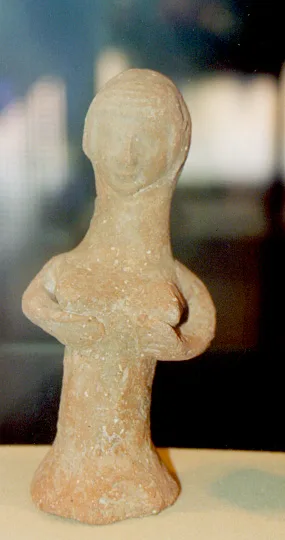
Asherah
Asherah is the principal goddess of the Israelite and Judahite cult, continuous with the Ugaritic Athirat, consort of El and mother of the gods. In the Hebrew Bible her name denotes both the deity and a wooden cult-symbol, an 'asherah', that stood beside altars and even within the Jerusalem temple until it was removed by reforming kings. Blessing inscriptions from Kuntillet ʿAjrud and Khirbet el-Qom invoke 'Yahweh and his asherah', evidence read by many scholars as pairing the goddess with Yahweh as his consort, though others take the term as his emblem; the sources genuinely differ. Household terracotta pillar figurines from Judah are frequently, if not unanimously, connected with her veneration in the domestic sphere of fertility and protection.
Domains
- fertility motherhood
- sacred tree
- blessing
Powers
- grants offspring and abundance
- gives birth to and nurses the gods
Epithets
- רַבַּת אֲתִרַת יַם — Lady Athirat of the SeaFrank Moore Cross, Canaanite Myth and Hebrew Epic (1973) (secondary)
Relations
- spouse: ElConsort of the high god El in the West Semitic pantheon.John Day, Yahweh and the Gods and Goddesses of Canaan (2000) (secondary)
- spouse: YahwehWhether the 'Asherah' of the blessing formulae is the goddess as Yahweh's consort or merely his wooden emblem is debated.Kuntillet ʿAjrud and Khirbet el-Qom inscriptions (primary); William G. Dever, Did God Have a Wife? (2005) (secondary)
Sources
- Asherah is a goddess of the Israelite-Judahite cult whose name and wooden symbol appear in the Hebrew Bible and who is paired with Yahweh in eighth-century inscriptions.: Kuntillet ʿAjrud pithos inscriptions, ed. Meshel, 2012 (primary); Khirbet el-Qom tomb inscription no. 3 (primary); Hebrew Bible, 1 Kings 15:13; 2 Kings 21:7; 23:4-7 (primary)
- Scholarship is divided over whether 'his asherah' in the blessings denotes the goddess as consort or a cult object.: Judith M. Hadley, The Cult of Asherah in Ancient Israel and Judah (2000) (secondary)