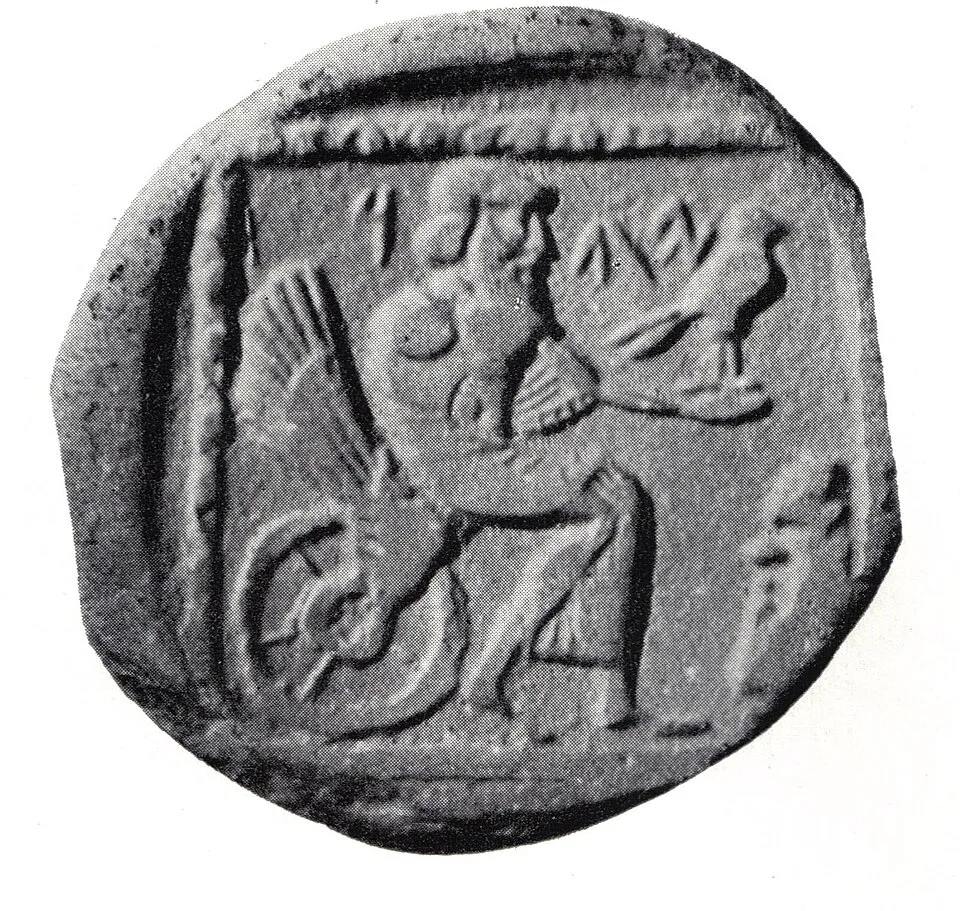
Yahweh
Yahweh is the national deity of the kingdoms of Israel and Judah and the central figure of the tradition that bears his name. In its earliest recoverable form the cult presents him as a warrior storm-god, riding the clouds, thundering from Sinai and Teman, and leading the heavenly and earthly hosts into battle. An older poetic stratum, preserved in the Song of Moses, sets him within a divine council presided over by El Elyon, who apportions the nations so that Israel falls to Yahweh as his own portion; in the mature religion El and Yahweh are wholly identified, and the epithets of the Canaanite high god pass to him. Popular practice, attested at Kuntillet ʿAjrud and Khirbet el-Qom, invokes 'Yahweh and his Asherah', a formula scholars read either as naming a consort goddess or as his wooden cult symbol. Over the Iron Age his worship moves from monolatry toward exclusive monotheism, culminating in the reforms ascribed to Hezekiah and Josiah, and he takes over from Baal the myth of combat against the chaotic Sea and its dragons.
Parentage
- parent: ElIn the older stratum reflected in Deuteronomy 32 Yahweh is reckoned among the sons of El Elyon; in mainstream Yahwism El and Yahweh are fully identified as one god.Hebrew Bible, Deuteronomy 32:8-9 (4QDeut/LXX reading 'sons of God') (primary); Mark S. Smith, The Origins of Biblical Monotheism (2001) (secondary)
Domains
- storm rain
- war
- kingship
- covenant law
Powers
- commands the thunderstorm and rain
- leads the heavenly host in battle
- subdues the primeval sea and its monsters
- grants and withdraws the breath of life
Epithets
- יְהוָה צְבָאוֹת — Yahweh of Hosts / Lord of ArmiesHebrew Bible, 1 Samuel 1:3; Isaiah 6:3 (primary)
- יהוה שמרן — Yahweh of SamariaKuntillet ʿAjrud pithos inscription, ed. Meshel, 2012 (primary)
- יהוה תמן — Yahweh of TemanKuntillet ʿAjrud pithos inscription, ed. Meshel, 2012 (primary)
- אֵל שַׁדַּי — God Almighty / El ShaddaiHebrew Bible, Exodus 6:3 (primary)
Relations
- parent: ElIn the older stratum reflected in Deuteronomy 32 Yahweh is reckoned among the sons of El Elyon; in mainstream Yahwism El and Yahweh are fully identified as one god.Hebrew Bible, Deuteronomy 32:8-9 (4QDeut/LXX reading 'sons of God') (primary); Mark S. Smith, The Origins of Biblical Monotheism (2001) (secondary)
- spouse: AsherahThe blessing formulae 'by Yahweh of Samaria/Teman and his Asherah' are read by many scholars as pairing Yahweh with the goddess as consort; others take 'asherah' as his cult symbol. Sources differ.Kuntillet ʿAjrud pithos inscriptions (Ḥorvat Teman), ed. Ze'ev Meshel, 2012 (primary); Khirbet el-Qom tomb inscription no. 3 (8th c. BCE) (primary)
- enemy: BaalThe prophetic literature casts Baal as Yahweh's chief rival for Israel's devotion.Hebrew Bible, 1 Kings 18:20-40 (contest on Mount Carmel) (primary)
- enemy: MotYahweh is promised to swallow up Death forever.Hebrew Bible, Isaiah 25:8; Hosea 13:14 (primary)
- enemy: LeviathanHebrew Bible, Psalm 74:14; Isaiah 27:1 (primary)
- enemy: RahabHebrew Bible, Psalm 89:10; Job 26:12 (primary)
- companion: Malʾak YahwehThe Angel of Yahweh acts as his emissary and, at times, as his very manifestation.Hebrew Bible, Exodus 23:20-23 (primary)
Sources
- Yahweh is the national god of Israel and Judah, worshipped from at least the early Iron Age and named on the Mesha Stele and in Hebrew inscriptions.: Mesha Stele (Moabite Stone), line 18, c. 840 BCE (primary); Kuntillet ʿAjrud and Arad ostraca; Lachish letters (primary); Mark S. Smith, The Early History of God (2nd ed., 2002) (secondary)
- The earliest possible attestation of the divine name is the Egyptian topographical reference to 'Yhw in the land of the Shasu' from the fourteenth century BCE.: Soleb temple topographical list of Amenhotep III, 'tꜣ šꜣsw yhwꜣ', c. 1400 BCE (primary); Donald B. Redford, Egypt, Canaan, and Israel in Ancient Times (1992) (secondary)
- Yahweh absorbs the storm-god's chaoskampf, defeating Sea, Leviathan and Rahab as Baal defeats Yam in Ugaritic myth.: John Day, God's Conflict with the Dragon and the Sea (1985) (secondary)