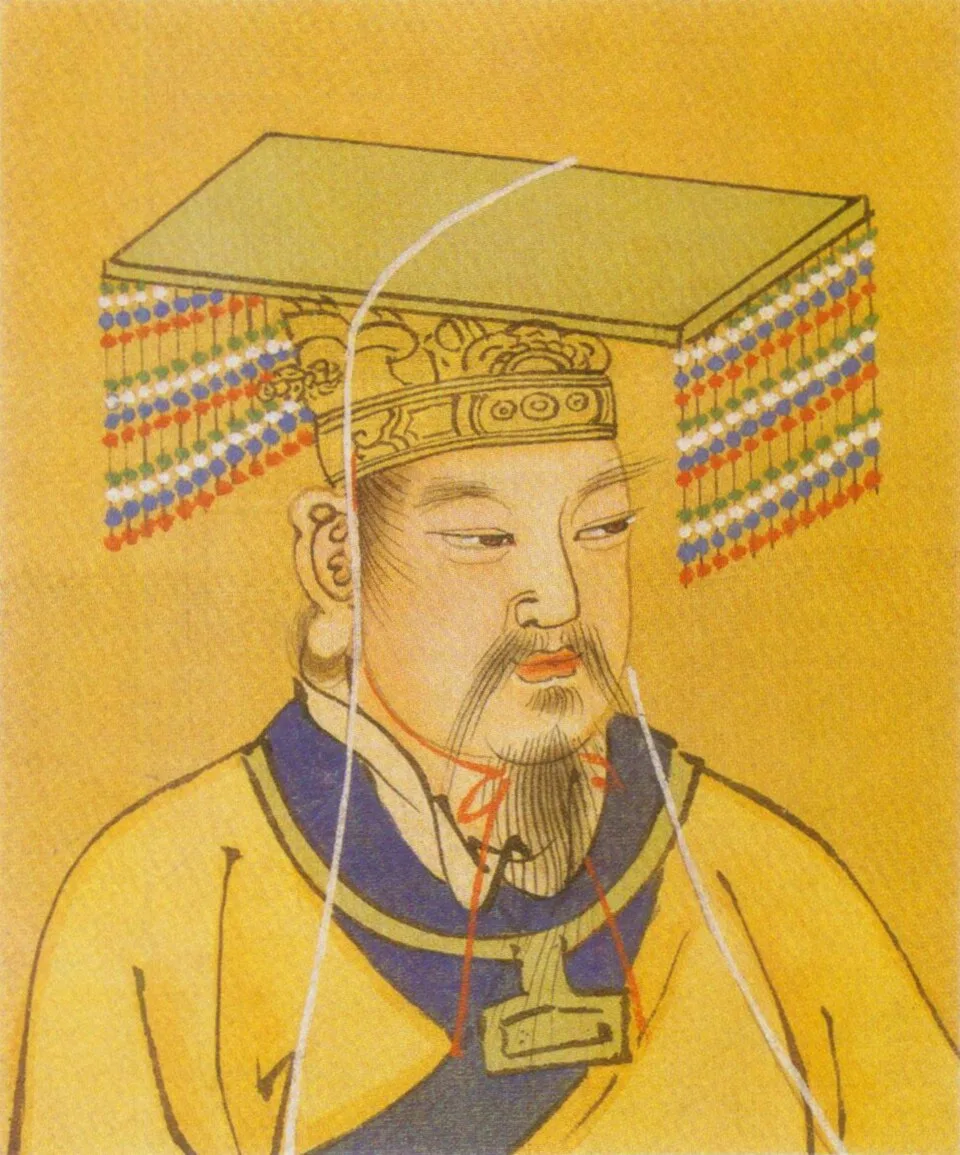
Huangdi
Yellow Emperor; sage-king founder of Chinese civilization; first of the Wu Di (Five Emperors) per the Shiji canonical-historical framework. Per Sima Qian's rationalized lineage, born to Shaodian (Sovereign of the Less Tribe, mortal regional sovereign) and Fubao; older mythological strata preserve the alternate celestial-lightning-conception tradition that the registry sets aside per strict-pass conventions, treating Huangdi as mortal with parentIds=[]. Traditional dating of his accession 2697 BCE is the conventional Chinese-historical anchor for the Yellow Emperor era and the foundational point of the Chinese imperial-historical framework. Defeated Yandi at the Battle of Banquan and Chiyou at the Battle of Zhuolu, unifying the proto-Chinese tribes of the Yellow River basin. Per the Shiji and supplementary traditions, established the foundational institutions of Chinese civilization: silk production (with Leizu), writing (with Cangjie), the Chinese calendar (sexagenary cycle), Chinese medicine (Huangdi Neijing), and the canonical-historical institutions of the imperial-state. The Qiaoshan Mausoleum continues as a major modern Chinese cultural-pilgrimage site; the Qingming-Festival Yellow-Emperor commemoration is a major modern Chinese cultural-political observance.
Children
Powers
- Gaze on the four quarters with four faces
- Defeat Chiyou at Zhuolu
- Ascend to heaven as an immortal on a dragon
Relations
- spouse: LeizuPrincipal consort Leizu, inventor of silk-production.Shiji Ch. 1 (primary)
- father of: ChangyiShiji Ch. 1 — Changyi as son of Huangdi and Leizu (primary)
Sources
- existence: Sima Qian, Shiji / Records of the Grand Historian (c. 91 BCE) Ch. 1 Wudi Benji (primary); Da Dai Liji (Han-period); Lushi Chunqiu (3rd c. BCE) (primary); K. C. Chang, Art, Myth, and Ritual (1983) (secondary); Sarah Allan, The Heir and the Sage (1981) (secondary)