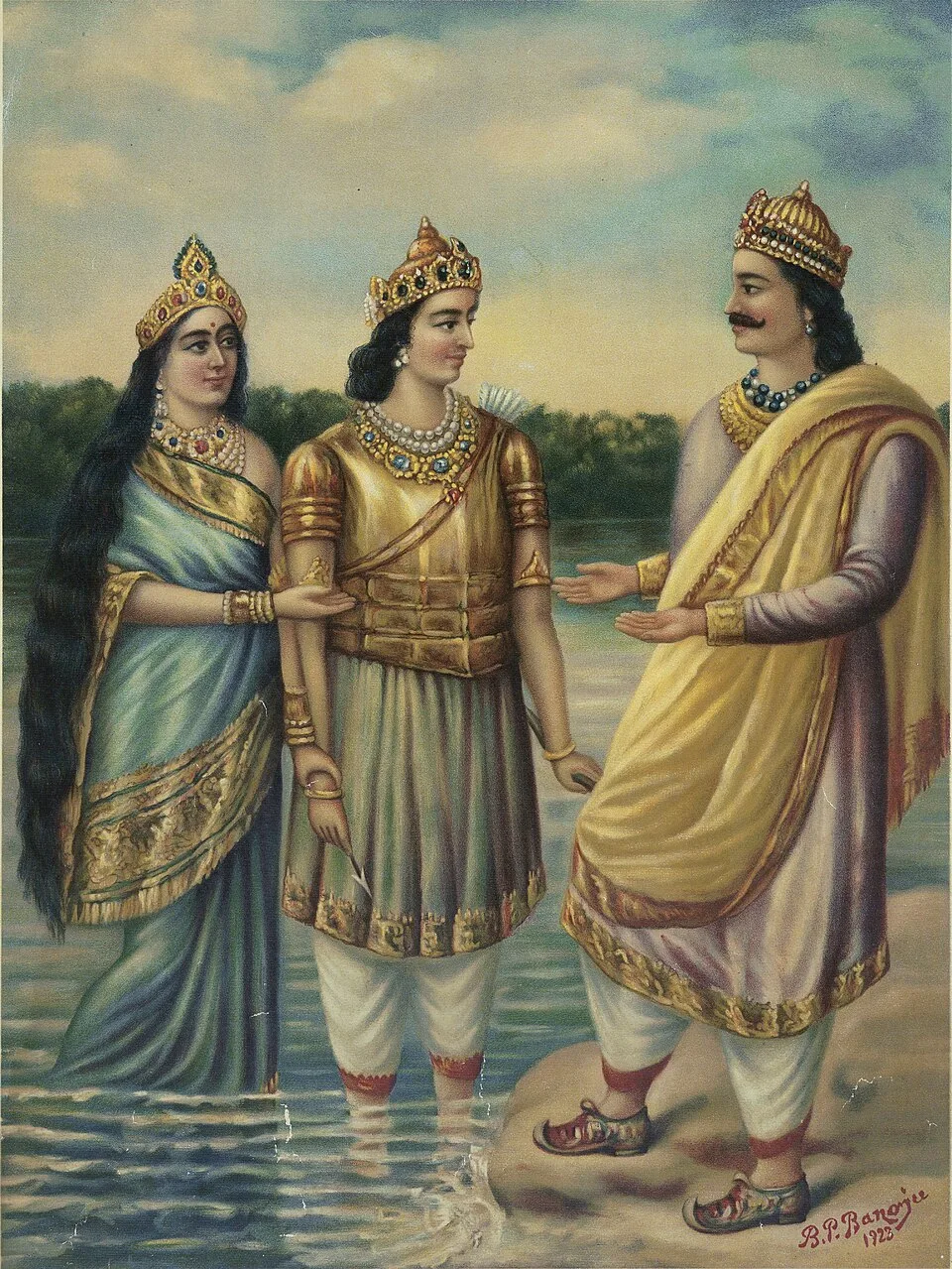
Bhīṣma
Demigod son of the river-goddess Ganga by the mortal Kuru king Shantanu of Hastinapura; one of the most fully developed characters in the Mahabharata and a continuing major figure in Hindu religious-cultural memory. Birth name Devavrata; received the name Bhīṣma ("of the terrible vow") after his double-vow of renunciation of the throne and lifelong celibacy, taken to enable his father Shantanu's second marriage to Satyavati. In gratitude Shantanu granted him icchamrityu — death-at-will. Educated by Vasishtha, Brihaspati, Shukra, and Parashurama. Kidnapped Amba, Ambika, and Ambalika of Kashi for Vichitravirya's marriage; Amba's rejection-rage produced her decades-long ascetic rebirth as Shikhandi, the eventual instrument of Bhishma's fall. Fought Parashurama in a twenty-three-day stalemate-duel. Served as regent of Hastinapura through the entire Pandava-Kaurava generation; bound by his vow of service to the throne, fought as commander of the Kaurava forces for the first ten days of the Kurukshetra war despite his moral preference for the Pandavas. Fell on the tenth day to Arjuna with Shikhandi placed before him (Bhishma's vow forbade fighting one born female). Lay 58 days on the bed of arrows (shara-shayya); chose through icchamrityu to wait for uttarayana (winter solstice) before releasing his prana; in those 58 days delivered the deathbed instruction to Yudhishthira on rajadharma, apaddharma, and moksha-dharma — the Shanti Parva and Anushasana Parva, the longest pedagogical sequence of the Mahabharata at c. 35,000+ verses, foundational text for Hindu political theory and dharma. Includes the Vishnu Sahasranama, the thousand names of Vishnu, recited in continuing daily Hindu practice. The Bhishmashtami observance (eighth day of the bright half of Magha) commemorates his death on uttarayana with tarpana water-offerings for ancestors. The strict-criterion classification follows the textual surface (Ganga + Shantanu biological parentage) with the Vasu-Dyaus karmic-incarnation reading recorded in variants[] — structurally parallel to the Mongán medieval-literary divine-paternity case, to Bhīma's Vāyu-incarnation framing, and to the Šulgi Ur III royal-hymn case.
Parentage
- parent: GaṅgāMahabharata Adi Parva 91-100 (primary)
- parent: ŚāntanuMahabharata Adi Parva 91-100 (primary)
Variant accounts
- Vasu-Dyaus-reborn-through-Vasishtha-curse
Domains
- regency of Hastinapura
- bhishma vow and celibate renunciate warrior paradigm
- pedagogue of rajadharma on arrow bed
Powers
- icchamrityu death at will
- Invokes celestial weapons in battle
- Dies only when he himself wills it
Epithets
- देवव्रत 'He of the divine vow' — his birth nameMahābhārata (Ādi Parva) (primary)
- गाङ्गेय 'Son of Gaṅgā'Mahābhārata (Ādi Parva) (primary)
- भीष्म 'The Terrible (one of the terrible vow)' — name earned by his vow of celibacyMahābhārata (Ādi Parva) (primary)
Relations
- half sibling: Vichitravirya
- parent: GaṅgāMahabharata Adi Parva 91-100 (primary)
- parent: ŚāntanuMahabharata Adi Parva 91-100 (primary)
- enemy: Ambā / ŚikhaṇḍīAmba/Shikhandi entry pending. The kidnapped princess of Kashi whose decades-long ascetic-rage rebirth as Shikhandi finally enabled Bhishma's fall on the tenth day of Kurukshetra.Mahabharata Adi Parva 102; Udyoga Parva 170-194 (primary)
- teacher of: YudhiṣṭhiraBhishma's 58-day deathbed instruction of Yudhishthira on rajadharma constitutes one of the longest pedagogical sequences in any world epic.Mahabharata Shanti Parva, Anushasana Parva (primary)
Sources
- existence: Mahabharata: Adi Parva 91-102 (birth, vow, kidnapping of the Kashi princesses); Udyoga Parva 170-194 (Amba narrative); Bhishma Parva 1-119 (commander of Kauravas, fall on tenth day); Shanti Parva 1-353 and Anushasana Parva 1-167 (the deathbed instruction of Yudhishthira); the Vishnu Sahasranama embedded in Anushasana Parva. Also: Bhagavata Purana 9.22; Vishnu Purana 4.20; the continuing Bhishmashtami observance (primary)
- parentage: Mahabharata Adi Parva 91-100 (primary)