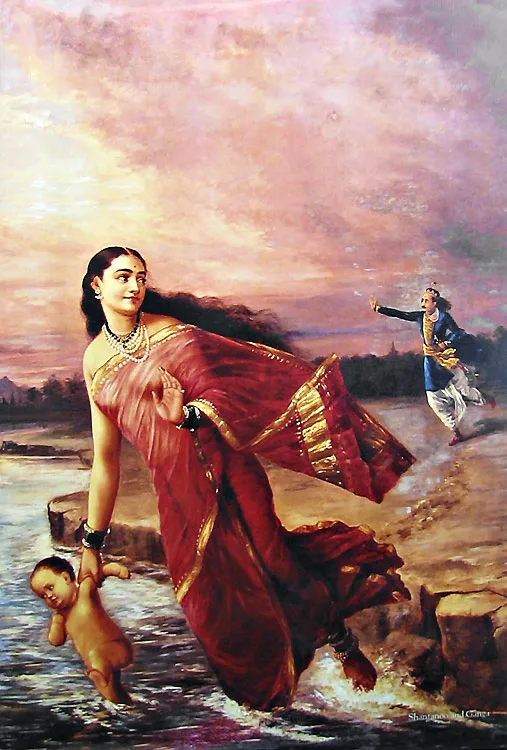
Gaṅgā
Hindu river-goddess; personification of the Ganges river. The most worshipped river-deity in Hinduism and arguably the most actively cultivated continuing female deity in any world religion (the daily Ganga Aarti at Varanasi has run continuously for centuries). First attested in the Rigveda (Nadistuti hymn, 10.75 — c. 1500-1200 BCE) where she is named in the standard list of seven sacred rivers. Iconographically standardized by the Gupta period riding her makara-vahana (crocodilian water-creature mount), holding a kalasha (water-pot). Mythological narrative-cycle: descended from heaven through the matted locks of Shiva to the Himalayas in response to Bhagiratha's thousand-year austerities, purifying the ashes of his ancestor Sagara's 60,000 sons (Ramayana Bala Kanda 42-44). Married Shantanu, mortal Kuru king of Hastinapura, under condition of unquestioning acceptance; bore him eight sons — the eight Vasus reborn through Vasishtha's curse for stealing his wish-fulfilling cow Nandini; drowned the first seven at birth in the Ganga to release them from their cursed mortal incarnations; on the eighth Shantanu intervened, breaking the condition; Ganga revealed the curse, returned the boy (Devavrata, later Bhishma — the Vasu Dyaus, chief of the eight and the most culpable, condemned to a long mortal life) to Shantanu when grown, and departed (Mahabharata Adi Parva 91-100). Foster-mother of Karttikeya/Skanda when Agni cast Shiva's seed upon her. Continuing major cult — Gangotri (the source), Haridwar (the plains-descent), Varanasi (Manikarnika cremation ghat), Allahabad/Prayagraj (Triveni Sangam — site of the 2025 Maha Kumbha Mela that drew over 600 million pilgrims, the largest single religious gathering in human history), Sagar Island (the mouth). Bathing in Ganga purifies all sins; death on her banks confers moksha. The Ganga is also a continuing object of major environmental and political contention as the most heavily polluted of the world's great sacred rivers.
Children
Children in alternative accounts
- Kartikeya: Rāmāyaṇa account in Wilkins: Agni and GaṅgāW. J. Wilkins, Hindu Mythology, Vedic and Puranic (1900), pp.335–341, Karttikeya: separate birth traditions (secondary)
Domains
- sacred river purification and moksha
- mother of Bhishma and Karttikeya
- descent via Bhagiratha penance
Powers
- Liberates souls into release
- Purifies and washes away sins
- Flows through heaven, earth, and netherworld
Epithets
- भागीरथी She brought down by king BhagīrathaVālmīki Rāmāyaṇa, Bāla Kāṇḍa 42-44 (Gaṅgāvataraṇa); Mahābhārata (primary)
- जाह्नवी Daughter of the sage Jahnu, who swallowed and released herMahābhārata, Ādi Parva; Vālmīki Rāmāyaṇa (primary)
- त्रिपथगा She who flows by three paths (heaven, earth, netherworld)Purāṇic Gaṅgā tradition; Devī Bhāgavata Purāṇa (primary)
Relations
- spouse: ŚāntanuMarried Shantanu under the condition that he never question her actions and never restrain her; bore him eight sons (the eight Vasus reborn through Vasishtha's curse); drowned the first seven in the Ganga at birth to release them from their cursed mortal incarnations. Shantanu intervened on the eighth, breaking the condition; Ganga revealed the Vasu-curse, returned the eighth (Devavrata, later Bhishma) to Shantanu when he was grown, and departed.Mahabharata Adi Parva 91-100 (primary)
- mother of: BhīṣmaMahabharata Adi Parva 91-100 (primary)
- foster mother of: Karttikeya / Skanda / Murugan (war-god, son of Shiva, foster-fostered by the Krittikas/Pleiades, related to Ganga) · HinduKarttikeya/Skanda entry pending. Foster-mother of Skanda when Agni cast Shiva's seed upon her.Mahabharata Vana Parva 224-230; Salya Parva 43-46; Ramayana Bala Kanda 36-37 (primary)