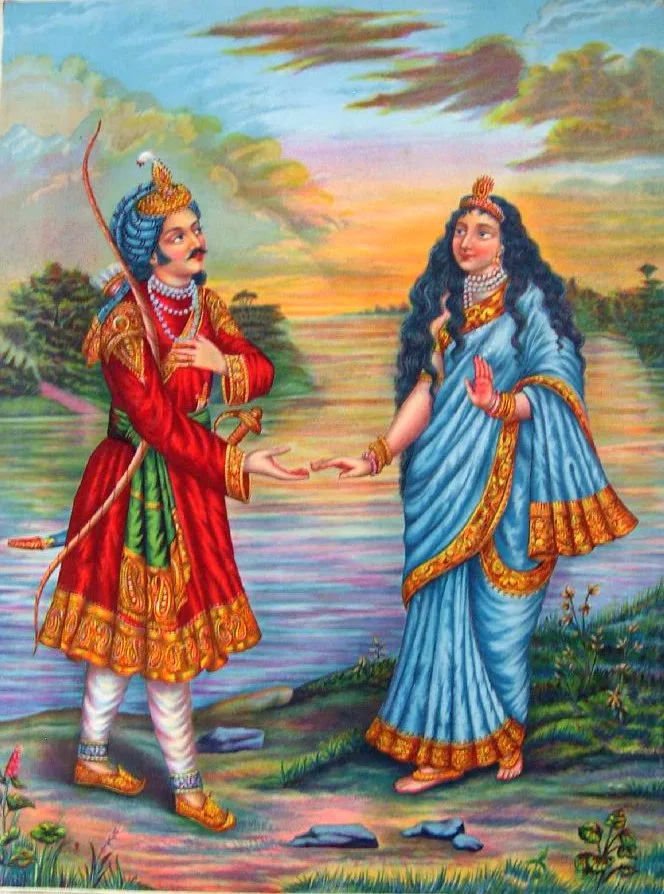
Śāntanu
Mortal Kuru king of Hastinapura; father of Bhishma (by Ganga) and Chitrangada and Vichitravirya (by Satyavati). Met the river-goddess Ganga in the form of a beautiful woman on the banks of the Ganges; married her under the condition of unquestioning acceptance. Bore eight sons by her; she drowned the first seven at birth (the Vasu-curse release); on the eighth Shantanu intervened, breaking the condition; lost Ganga, who took the boy (Devavrata) with her. Reunited with the grown Devavrata sixteen years later. Years later, his desire to marry the fisher-woman Satyavati prompted Devavrata's bhīṣma-vow of renunciation and celibacy — for which Shantanu granted Devavrata the boon of icchamrityu (death-at-will). Bore Chitrangada and Vichitravirya by Satyavati but died before either could rule effectively. Forms the structural foundation of the Mahabharata's Kuru-dynastic crisis: his second-marriage compromise produces Bhishma's vow, which produces the throne-succession problem (no Bhishma descendants), which produces the niyoga-conception of Dhritarashtra and Pandu by Vyasa on the widows of Vichitravirya, which produces the Pandava-Kaurava rivalry that culminates in the Kurukshetra war.
Parentage
- parent: Pratipa
Children
Domains
- kingship of Hastinapura
Powers
- Restores aged people to youth and pleasure by his touch
Relations
- sibling: Bahlika
- sibling: Devapi
- parent: Pratipa (Kuru king, father of Shantanu, grandfather of Bhishma) · HinduPratipa of the Kuru dynasty entry pending. Father.Mahabharata Adi Parva 90 (primary)
- spouse: GaṅgāMahabharata Adi Parva 91-99 (primary)
- spouse: SatyavatīSatyavati entry pending. Second wife; mother of Chitrangada and Vichitravirya; also (in pre-marriage union with sage Parashara) mother of Vyasa, the redactor of the Mahabharata.Mahabharata Adi Parva 100-102 (primary)
- father of: BhīṣmaMahabharata Adi Parva 91-100 (primary)
- father of: Chitrangada (eldest son of Shantanu by Satyavati, Kuru king killed in single combat by a Gandharva of the same name) · HinduChitrangada entry pending. Son by Satyavati; killed young in single combat by a Gandharva of the same name.Mahabharata Adi Parva 101-102 (primary)
- father of: Vichitravirya (younger son of Shantanu by Satyavati, Kuru king, dies young of consumption, niyoga-fathered through Vyasa) · HinduVichitravirya entry pending. Son by Satyavati; died of consumption shortly after marriage to Ambika and Ambalika.Mahabharata Adi Parva 102 (primary)