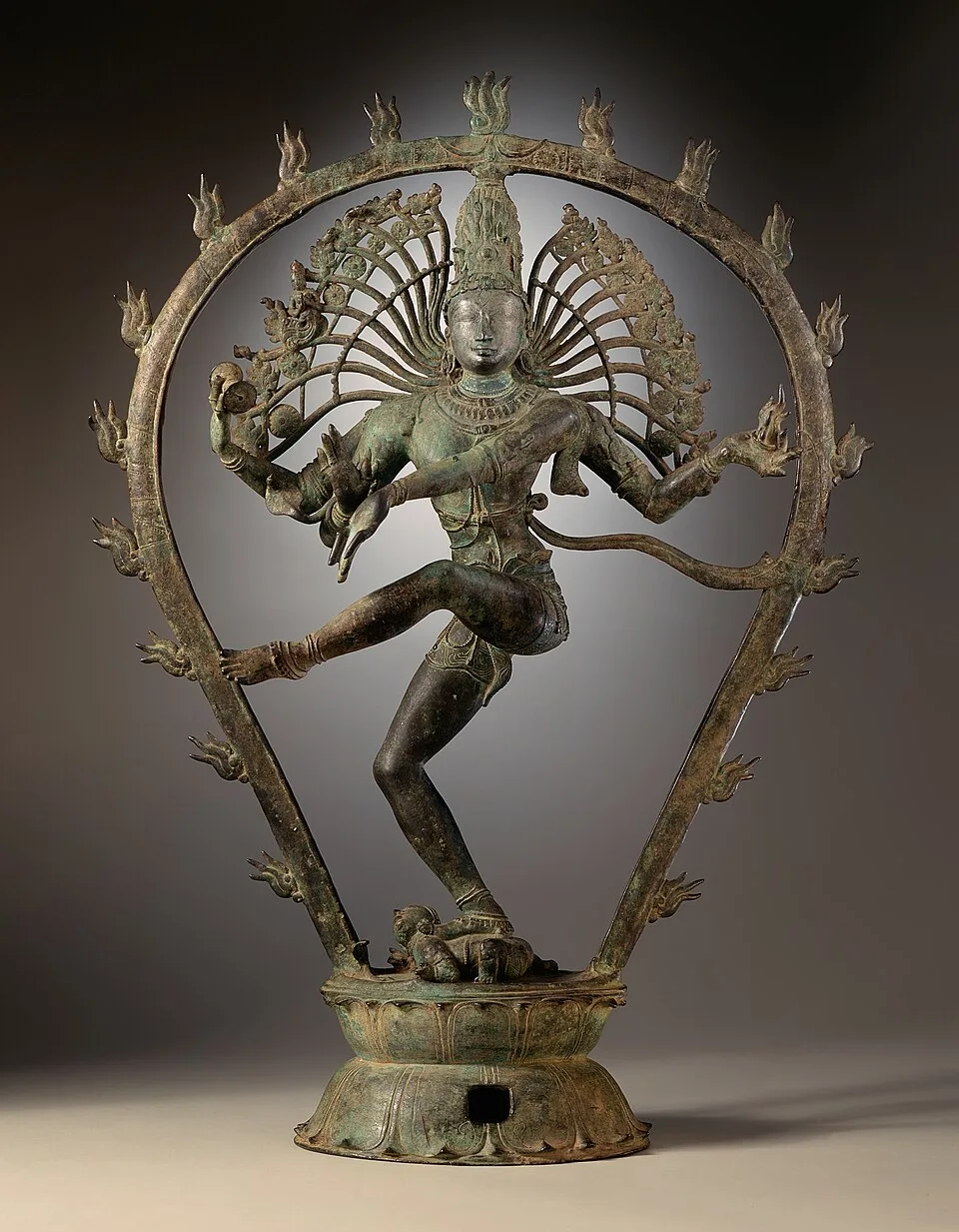
Shiva
Hindu · deity · primordial · Recorded classification
Supreme deity of destruction, asceticism, and regeneration; the great yogin
Parentage
Recorded default; alternative parentage accounts are listed separately below.
No parents recorded in the default.
Parentage accounts
Each account is a separate source claim. The parentage and children listed outside these accounts use the recorded default. Selecting an account in the interactive app updates its lineage, descent classification and inherited-power candidates. Linked pedigree accounts are selected together; other records retain their recorded parentage. Claims of ancestry are not proof of biological descent or attested powers.
- Shiva Purana 2.1.15.55–65, manifestation of Rudra
deity by descent in this account.
No parents recorded in this account.
Shiva Purana 2.1.15.55–65, manifestation of Rudra (primary)
Children
Children in alternative accounts
- Nandi: Called son by Śiva and Pārvatī at coronation (social kinship)Shiva Purana 3.7.10–22, 31–57, coronation and marriage (primary)
Names and tradition associations
- Oesho William W. Malandra, VĀYU, opening discussion of OEŠO and Iranian etymology (2014/2015) (secondary); Metropolitan Museum of Art, object 2000.42.4, Panel fragment with the god Shiva/Oesho, Bactria, ca. third century CE (secondary)
- Rudra Rigveda 2.33.1–15, Griffith translation (primary); Rudra, introductory identification and Rudra and Shiva section (encyclopedia)
- Bathou Bwrai Sidney Endle, The Kacharis (1911), pp. 35–37 and Appendix I p. 82 (secondary)
- Mallikārjuna Shiva Purana 2.4.20.1–8, 23–37 and editorial note 3 (primary)
- Bhairava Shiva Purana 3.8.2, 45–65 and note 1, Bhairava (primary)
- Ardhanārīśvara Shiva Purana 3.3.1–30 and note 1, half-female form (primary)
- Nataraja Metropolitan Museum of Art, 1987.80.1, Shiva as Lord of Dance (Nataraja), object description (secondary)
- Batara Guru Batara Guru, introductory discussion, Javanese section and reference 2 quoting Bernet Kempers p. 83 (encyclopedia)
- Paruhang Paruhang and Sumnima, description of the Rai pair and references (encyclopedia)
- Mahandeo Kalash people, Mahandeo section (name only); earlier Jettmar/Parkes identification requires passage verification (encyclopedia)
- Batara Guru (Malay) Walter W. Skeat, Malay Magic (1900), pp.85–96: greater gods, sea-spirit family and black/white genii (secondary)
- Batara Guru (Javanese Kanda) Batara Guru, Javanese portrayal and names (encyclopedia)
- Kapālin (eleven Rudras) Shiva Purana 3.18.24–31, eleven Rudras born to Surabhi and Kashyapa (primary)
- Piṅgala (eleven Rudras) Shiva Purana 3.18.24–31, eleven Rudras born to Surabhi and Kashyapa (primary)
- Bhīma (eleven Rudras) Shiva Purana 3.18.24–31, eleven Rudras born to Surabhi and Kashyapa (primary)
- Virūpākṣa (eleven Rudras) Shiva Purana 3.18.24–31, eleven Rudras born to Surabhi and Kashyapa (primary)
- Vilohita (eleven Rudras) Shiva Purana 3.18.24–31, eleven Rudras born to Surabhi and Kashyapa (primary)
- Śāstṛ (eleven Rudras) Shiva Purana 3.18.24–31, eleven Rudras born to Surabhi and Kashyapa (primary)
- Ajapād (eleven Rudras) Shiva Purana 3.18.24–31, eleven Rudras born to Surabhi and Kashyapa (primary)
- Ahirbudhnya (eleven Rudras) Shiva Purana 3.18.24–31, eleven Rudras born to Surabhi and Kashyapa (primary)
- Śiva (eleven Rudras) Shiva Purana 3.18.24–31, eleven Rudras born to Surabhi and Kashyapa (primary)
- Caṇḍa (eleven Rudras) Shiva Purana 3.18.24–31, eleven Rudras born to Surabhi and Kashyapa (primary)
- Bhava (eleven Rudras) Shiva Purana 3.18.24–31, eleven Rudras born to Surabhi and Kashyapa (primary)
- Gṛhapati Shiva Purana 3.13.1–8, Vishvanara and Shucishmati; 3.14 birth narrative (primary)
- Pippalāda Shiva Purana 3.24.1–5, 41–63, Pippalada’s family and manifestation (primary)
- Lha Chenpo Jeff Watt, Himalayan Art Resources, Lha Chenpo: Nyingma and Mindrolling contexts (secondary)
- Mahākāla (Śatarudra 3.17) Shiva Purana 3.17.1–18, ten named forms and their Shaktis (primary)
- Tāra (Śatarudra 3.17) Shiva Purana 3.17.1–18, ten named forms and their Shaktis (primary)
- Bāla (Śatarudra 3.17) Shiva Purana 3.17.1–18, ten named forms and their Shaktis (primary)
- Śrīvidyeśa Ṣoḍaśa (Śatarudra 3.17) Shiva Purana 3.17.1–18, ten named forms and their Shaktis (primary)
- Bhairava (Śatarudra 3.17) Shiva Purana 3.17.1–18, ten named forms and their Shaktis (primary)
- Chinnamastaka (Śatarudra 3.17) Shiva Purana 3.17.1–18, ten named forms and their Shaktis (primary)
- Dhūmavān (Śatarudra 3.17) Shiva Purana 3.17.1–18, ten named forms and their Shaktis (primary)
- Bagalāmukha (Śatarudra 3.17) Shiva Purana 3.17.1–18, ten named forms and their Shaktis (primary)
- Mātaṅga (Śatarudra 3.17) Shiva Purana 3.17.1–18, ten named forms and their Shaktis (primary)
- Kamala (Śatarudra 3.17) Shiva Purana 3.17.1–18, ten named forms and their Shaktis (primary)
Variant accounts
- originThis account calls Rudra unborn while describing his manifestation from the region between Brahma’s eyebrows and nose. It does not present biological birth from Brahma.Shiva Purana 2.1.15.55–65, manifestation of Rudra (primary)
- cult locationShiva Purana 2.4.20 places the Mallikarjuna form on Krauncha. The translation’s note 3 distinguishes that narrative from the southern Srisaila identification.Shiva Purana 2.4.20.1–8, 23–37 and editorial note 3 (primary)
- manifestationThe half-male, half-female form separates its Shakti to enable Brahma’s paired creation and reunites afterward. It is a manifestation account, not biological ancestry.Shiva Purana 3.3.1–30 and note 1, half-female form (primary)
- iconographyThe Met’s late-eleventh-century Tamil Nataraja carries a drum and flame within a fiery halo, offers reassurance with a hand gesture, and tramples a figure of illusion. This is a cult image, not a separate family.Metropolitan Museum of Art, 1987.80.1, Shiva as Lord of Dance (Nataraja), object description (secondary)
- Disguise in the Gṛhapati narrativeThe threatening Indra in this episode is revealed to have been Śiva’s disguise.Shiva Purana 3.15.50–58, Grihapati receives Agni’s office; Agnishvara (primary)
- Ten forms and named energiesThe chapter pairs Mahākāla with Mahākālī, Tāra with Tārā, Bāla with Śivā, Śrīvidyeśa Ṣoḍaśa with Śrīvidyā Ṣoḍaśī, Bhairava with Bhairavī, Bagalāmukha with Bagalāmukhī/Mahānandā, Mātaṅga with Mātaṅgī and Kamala with Kamalā. The accessed translation names Dhūmāvatī twice, with Chinnamastaka and Dhūmavān; that reading is retained without silently substituting another goddess.Shiva Purana 3.17.1–18, ten named forms and their Shaktis (primary)
Domains
- destruction
- asceticism
- storm howling
Powers
- Dance the cosmic dance of creation and dissolution
- Incinerate to ash with a glance of the third eye
- Hold the world-poison in the throat
- Bear the descending river Ganga in matted locks
Epithets
- महादेव The Great God; supreme name of ShivaMahābhārata, Anuśāsana Parva 17 (Śiva-sahasranāma); Śiva Purāṇa (primary)
- नटराज Lord of the Dance; Shiva as cosmic dancer of the ānanda-tāṇḍavaA. K. Coomaraswamy, 'The Dance of Shiva' (1918); Chidambaram temple tradition (secondary)
- नीलकण्ठ The Blue-Throated, from holding the hālāhala poison at the churning of the oceanMahābhārata, Ādi Parva 18; Viṣṇu Purāṇa 1.9 (primary)
- त्र्यम्बक The Three-Eyed One; invoked in the Mahāmṛtyuñjaya mantraṚgveda 7.59.12 (Tryambaka / Mahāmṛtyuñjaya mantra); Yajurveda (primary)
- शङ्कर The Beneficent, the Maker of blissŚiva Purāṇa; Liṅga Purāṇa (primary)
- रुद्र The Howler / the Fierce; the Vedic antecedent of ShivaYajurveda, Śatarudrīya (Rudram), Taittirīya Saṃhitā 4.5 (primary)
- महेश्वर The Great Lord; the supreme sovereign deityŚvetāśvatara Upaniṣad; Śiva Purāṇa (primary)
- पशुपति Lord of creatures and beastsŚatarudrīya (Vājasaneyi Saṃhitā 16; Taittirīya Saṃhitā 4.5) (primary)
- गिरीश Lord of the mountain (Kailāsa)Śatarudrīya (Vājasaneyi Saṃhitā 16.2, 16.20) (primary)
- गङ्गाधर Bearer of the Ganges, caught in his matted locksŚiva Purāṇa; the descent-of-Gaṅgā tradition (Rāmāyaṇa 1.43) (primary)
Relations
- disputed identification: OeshoKushan imagery is identified with Shiva, while Malandra derives the name Oesho from Iranian Vayu. The relation records an interpretive question, not an unqualified identity or shared genealogy.William W. Malandra, VĀYU, opening discussion of OEŠO and Iranian etymology (2014/2015) (secondary); Metropolitan Museum of Art, object 2000.42.4, Panel fragment with the god Shiva/Oesho, Bactria, ca. third century CE (secondary)
- interpretatio: Lord of Crops and WarMahandeo is the registered Kalash endpoint. The existing nominal comparison requires verification of the cited scholarship and supplies no shared family.Karl Jettmar, Die Religionen des Hindukusch (1975), on the name Mahandeo < Skt. Mahādeva (secondary); Kalash people, Mahandeo section (name only); earlier Jettmar/Parkes identification requires passage verification (encyclopedia)
- companion: NandiReciprocal of hindu_nandi.companion — Bull mount, gatekeeper, and foremost devotee/attendant (gana) of Shiva; not a blood relation, hence companion.Shiva Purana, Shatarudra Samhita (Nandi, the bull-vehicle and chief gana/gatekeeper of Shiva) (primary)
- spouse: ParvatiReciprocal of hindu_parvati.spouse — Daughter of Himavat; consort of Shiva; mother of Ganesha and Kartikeya, both of whom already register her as parent.Shiva Purana, Rudra Samhita (Parvati Khanda) (marriage of Shiva and Parvati) (primary)
- counterpart of: Rudra (Rigvedic hymns)The Rigvedic portrayal is recorded separately from later Puranic accounts; the hymn alone does not establish their historical development.Rigveda 2.33.1–15, Griffith translation (primary); Rudra, introductory identification and Rudra and Shiva section (encyclopedia)
- manifested through: BrahmaShiva Purana 2.1.15.55–65, manifestation of Rudra (primary)
- manifestation: Bhairava (Śatarudra account)Shiva Purana 3.8.2, 45–65 and note 1, Bhairava (primary)
- identified in account: Batara GuruSkeat’s interpretation of Malay ritual and romance; independent Malay portrayals retain their own families.Walter W. Skeat, Malay Magic (1900), pp.85–96: greater gods, sea-spirit family and black/white genii (secondary)
- regional cult form: Batara Guru (Javanese)Javanese textual portrayal with independent creation and family accounts.Batara Guru, Javanese portrayal and names (encyclopedia)
- incarnation: Kapālin (eleven Rudras)Shiva Purana 3.18.24–31, eleven Rudras born to Surabhi and Kashyapa (primary)
- incarnation: Piṅgala (eleven Rudras)Shiva Purana 3.18.24–31, eleven Rudras born to Surabhi and Kashyapa (primary)
- incarnation: Bhīma (eleven Rudras)Shiva Purana 3.18.24–31, eleven Rudras born to Surabhi and Kashyapa (primary)
- incarnation: Virūpākṣa (eleven Rudras)Shiva Purana 3.18.24–31, eleven Rudras born to Surabhi and Kashyapa (primary)
- incarnation: Vilohita (eleven Rudras)Shiva Purana 3.18.24–31, eleven Rudras born to Surabhi and Kashyapa (primary)
- incarnation: Śāstṛ (eleven Rudras)Shiva Purana 3.18.24–31, eleven Rudras born to Surabhi and Kashyapa (primary)
- incarnation: Ajapād (eleven Rudras)Shiva Purana 3.18.24–31, eleven Rudras born to Surabhi and Kashyapa (primary)
- incarnation: Ahirbudhnya (eleven Rudras)Shiva Purana 3.18.24–31, eleven Rudras born to Surabhi and Kashyapa (primary)
- incarnation: Śiva (eleven Rudras)Shiva Purana 3.18.24–31, eleven Rudras born to Surabhi and Kashyapa (primary)
- incarnation: Caṇḍa (eleven Rudras)Shiva Purana 3.18.24–31, eleven Rudras born to Surabhi and Kashyapa (primary)
- incarnation: Bhava (eleven Rudras)Shiva Purana 3.18.24–31, eleven Rudras born to Surabhi and Kashyapa (primary)
- incarnation: GṛhapatiShiva Purana 3.13.1–8, Vishvanara and Shucishmati; 3.14 birth narrative (primary)
- incarnation: Pippalāda (Śatarudra account)Shiva Purana 3.24.1–5, 41–63, Pippalada’s family and manifestation (primary)
- identified in account: Lha ChenpoJeff Watt, Himalayan Art Resources, Lha Chenpo: Nyingma and Mindrolling contexts (secondary)
Sources
- existence: Rigveda (Rudra hymns) (primary); Shiva Purana (primary)