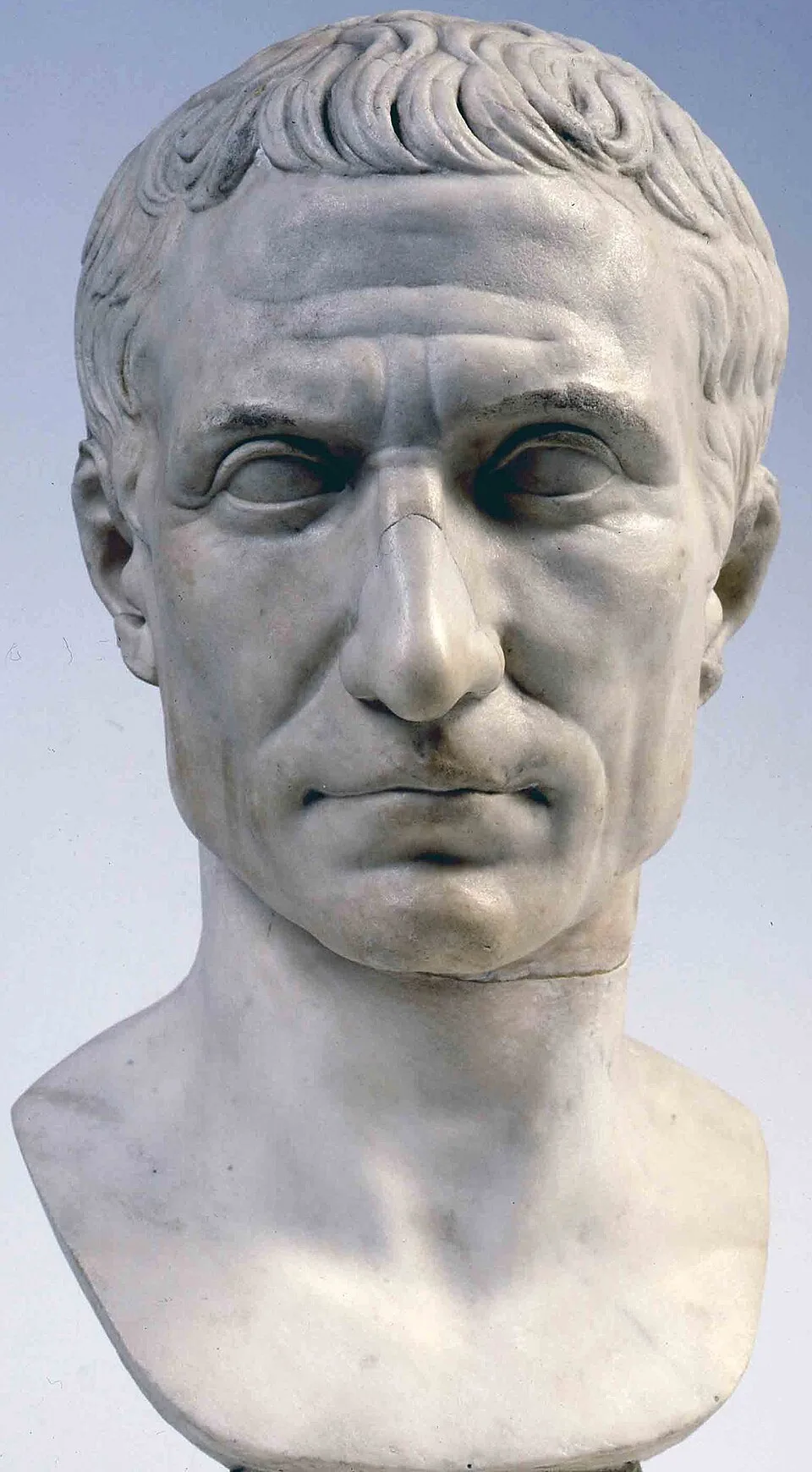
Gaius Iulius Caesar
Mortal-floor (Aeneas-Ascanius-Iulus divine-line annotation through the canonical gens-Iulia eponymic genealogy) Roman dictator and statesman (100-44 BCE); officially deified post-mortem by Senate vote on 1 January 42 BCE as Divus Iulius — the first Roman individual officially deified by the Senate. The post-mortem deification was preceded and "confirmed" by the sidus Iulium comet during his July 44 BCE funeral games per Pliny NH 2.93-94. Conducted the Gallic Wars (58-50 BCE) preserved in his own seven-book commentary De Bello Gallico; crossed the Rubicon on 10 January 49 BCE initiating the civil war against Pompey; defeated the optimates at Pharsalus (48), Thapsus (46), and Munda (45); held the perpetual dictatorship from February 44 BCE; assassinated on the Ides of March 44 BCE in the Curia of Pompey by a conspiracy of senators including Brutus and Cassius. Posthumously adopted Octavian (his great-nephew) in his will; Octavian thereafter claimed the divi filius ("son of the deified") title after Caesar's 42 BCE Senate deification — the foundation of the Augustan principate's religious-ideological architecture. Father of Iulia Caesaris by Cornelia Cinna minor, and of Caesarion by Cleopatra VII.
Parentage
- father: Gaius Iulius Caesar IIISuetonius, Divus Iulius 1 (primary)
- mother: Aurelia CottaSuetonius, Divus Iulius 1 (primary)
Children
Powers
- Ascends to heaven and is set among the stars
Epithets
- Dictator Perpetuo Dictator in perpetuity (44 BCE)Suetonius, Julius; coin legends (primary)
- Pater Patriae Father of the Fatherland (45 BCE)Suetonius, Julius; Cassius Dio 44 (primary)
- Divus Iulius the Deified Julius (deified 42 BCE)Suetonius, Julius; Cassius Dio 47 (primary)
Relations
- father: Gaius Iulius Caesar IIISuetonius, Divus Iulius 1 (primary)
- mother: Aurelia CottaSuetonius, Divus Iulius 1 (primary)
- father of: Iulia CaesarisBy his first wife Cornelia Cinna minor.Suetonius, Divus Iulius 1 (primary)
- father of: Caesarion (Ptolemy XV Philopator Philometor Caesar, son of Cleopatra VII, killed by Octavian after Actium 30 BCE) · RomanSuetonius, Divus Iulius 52; Plutarch, Caesar 49 (primary)
- social father: Octavian-Augustus (great-nephew through Caesar's sister Iulia Minor; adopted in Caesar's will posthumously) · RomanPosthumously adopted Octavian (great-nephew) in his will read March 44 BCE; Octavian thereafter was legally Gaius Iulius Caesar Octavianus, claiming the divi filius ("son of the deified") title after Caesar's 42 BCE deification.Suetonius, Divus Iulius 83; Suetonius, Divus Augustus 8 (primary)
- killed by: the conspiracy of Marcus Iunius Brutus, Gaius Cassius Longinus, Decimus Iunius Brutus Albinus, and ~60 other senators · RomanSuetonius, Divus Iulius 80-82 (primary)
- sibling: Iulia MinorReciprocal of roman_iulia_minor_caesaris.sibling (alphabetical family sweep). (auto reciprocal)
Sources
- existence: Caesar's own De Bello Gallico and De Bello Civili (primary); Suetonius, Divus Iulius (the canonical biography, the first life in De Vita Caesarum) (primary); Plutarch, Caesar; Plutarch, Brutus; Plutarch, Antony; Plutarch, Pompey (primary); Cassius Dio, Roman History books 37-44 (primary); Appian, Bellum Civile 2 (primary); Sallust, Bellum Catilinae and Bellum Iugurthinum (contemporary) (primary); Cicero, Letters and Speeches (contemporary, vast corpus) (primary)