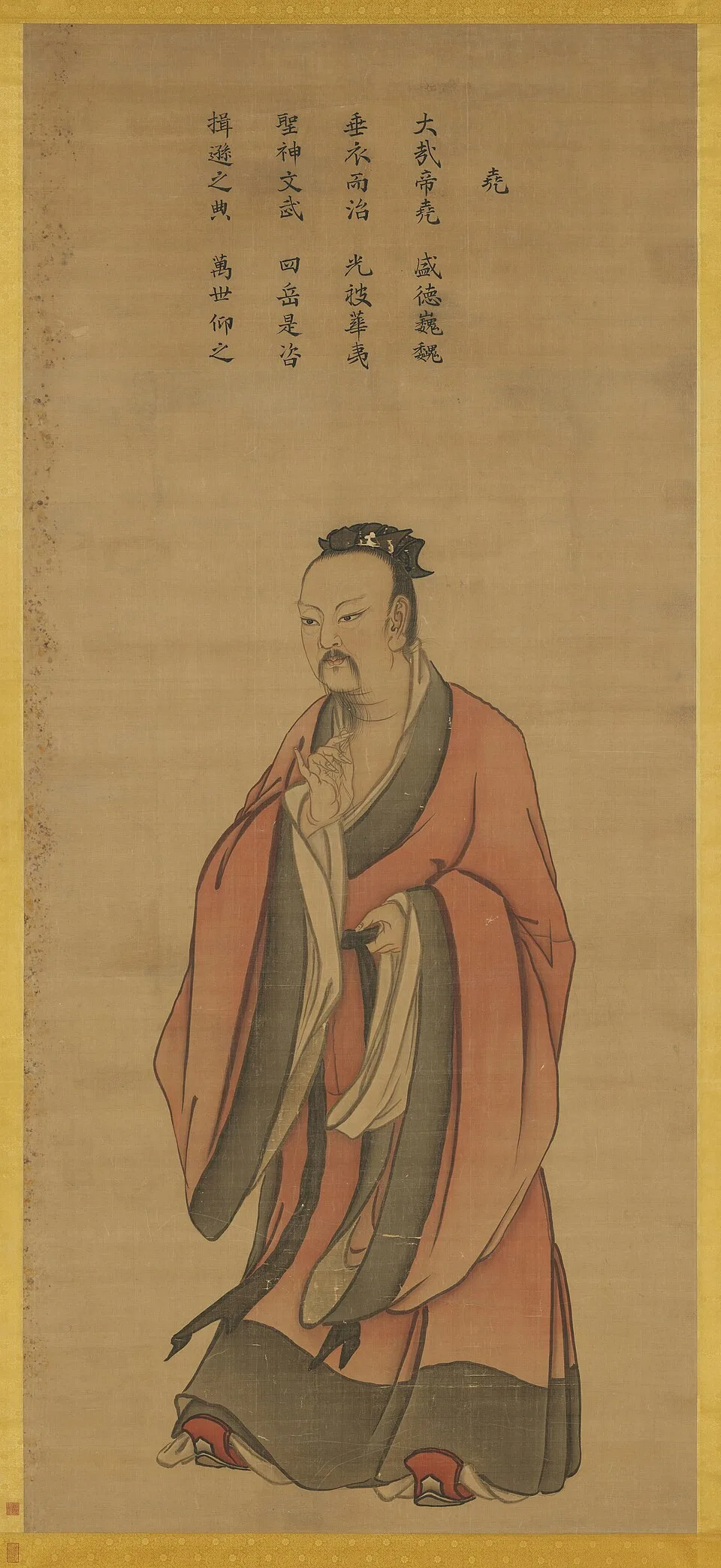
Yao
Fourth of the Wu Di (Five Emperors) per the Shiji canonical-historical framework; the foundational Sage-King of the Confucian-canonical tradition; son of Diku by his consort Qing Du. The foundational meritocratic-succession episode — Yao's abdication to Shun (a commoner of exemplary virtue) rather than to his own son Danzhu — established the template of merit-based succession that became one of the most-discussed political-philosophical episodes in Chinese intellectual history. Mencius (5A.5-6) treats the Yao-Shun abdication as the foundational case-study of Tian-Ming (Mandate of Heaven) succession-legitimacy: the throne is the gift of Heaven and the people, not heritable property of the sovereign. The Confucian-canonical idealization of Yao as exemplar of sage-king moral-frugality (the austere thatched residence, the personal labor in the fields, the elevation of capable ministers regardless of social origin) made him the foundational moral-political archetype of subsequent Chinese imperial-rhetorical tradition.
Parentage
- paternal: Diku
Children
Domains
- kingship
- calendar
Powers
- Order the calendar and the seasons
- Yield the throne to the worthy
Epithets
- 陶唐氏 of the Tao-Tang clan (from his fiefs Tao and Tang)Sima Qian, Shiji, 'Annals of the Five Emperors' (primary)
- 放勳 'Far-reaching Merit', personal name of YaoShangshu, 'Canon of Yao' (primary)
Relations
- half sibling: Houji
- half sibling: Xie
- half sibling: Zhi
- father of: EhuangGave his two daughters Ehuang and Nuying to Shun in marriage to test his virtue.Shiji Ch. 1; Shujing Yao Dian (primary)
- father of: NuyingShiji Ch. 1; Shujing Yao Dian (primary)
Sources
- existence: Sima Qian, Shiji Ch. 1 (primary); Shujing — Yao Dian (primary); Mencius / Mengzi 5A.4-6 (primary)