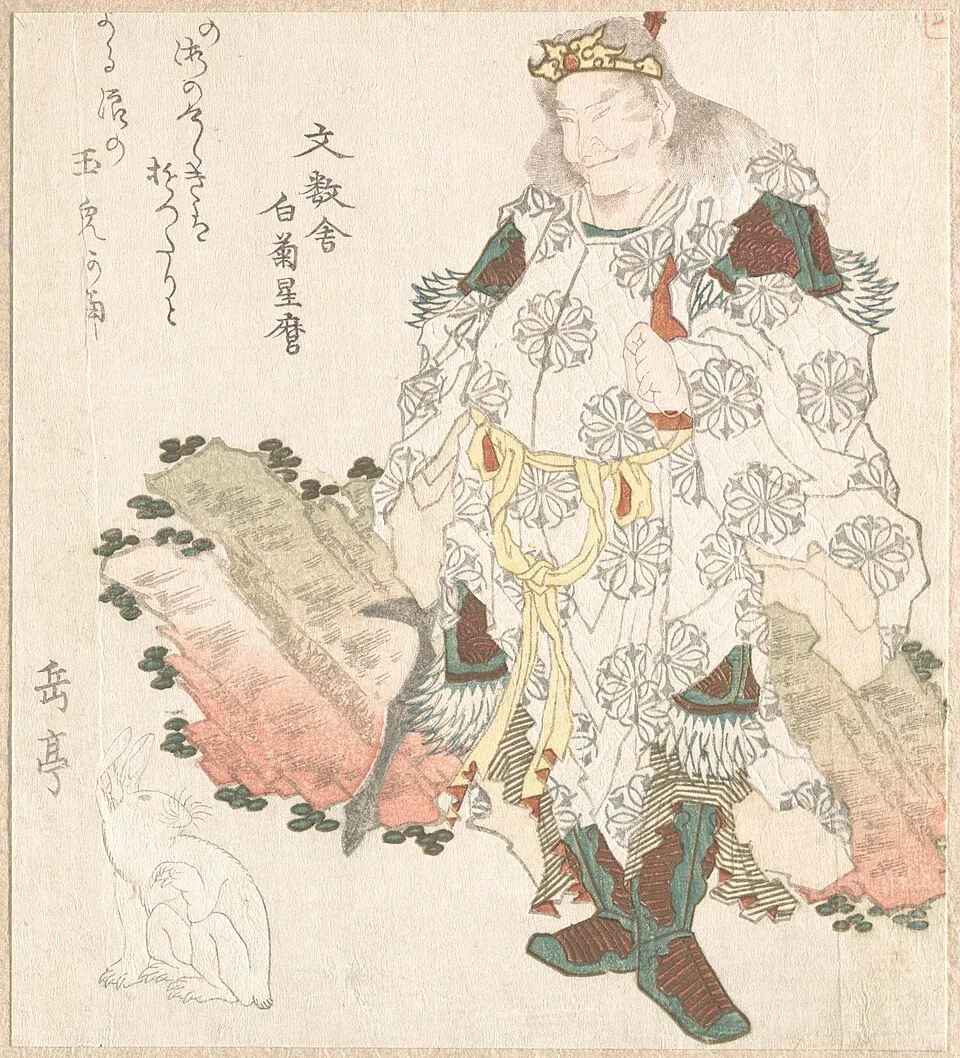
Ōkuninushi
Japanese · deity · primordial · Recorded classification
Descendant of Susanoo who built the land and ceded it in the kuni-yuzuri.
Parentage
Recorded default; alternative parentage accounts are listed separately below.
- parent: Ame-no-fuyukinuKojiki, section XX, ancestors of Okuninushi; Chamberlain translation and notes 1–22 (primary)
- parent: Sashikuni-wakahimeKojiki, section XX, ancestors of Okuninushi; Chamberlain translation and notes 1–22 (primary)
Parentage accounts
Each account is a separate source claim. The parentage and children listed outside these accounts use the recorded default. Selecting an account in the interactive app updates its lineage, descent classification and inherited-power candidates. Linked pedigree accounts are selected together; other records retain their recorded parentage. Claims of ancestry are not proof of biological descent or attested powers.
- Kojiki, section XX, ancestors of Okuninushi; Chamberlain translation and notes 1–22
deity by descent in this account.
- parent: Ame-no-fuyukinuKojiki, section XX, ancestors of Okuninushi; Chamberlain translation and notes 1–22 (primary)
- parent: Sashikuni-wakahimeKojiki, section XX, ancestors of Okuninushi; Chamberlain translation and notes 1–22 (primary)
- Mark Schumacher, Daikokuten, Historical Notes and Shinto associations
deity by descent in this account.
- parent: SusanooMark Schumacher, Daikokuten, Historical Notes and Shinto associations (secondary)
- Nihongi I, Aston translation, I.50–55: marriage and alternative descents
deity by descent in this account.
- parent: SusanooNihongi I, Aston translation, I.50–55: marriage and alternative descents (primary)
- parent: Kushinada-himeNihongi I, Aston translation, I.50–55: marriage and alternative descents (primary)
Children
Names and tradition associations
- Daikoku Mark Schumacher, Daikokuten, Historical Notes and Shinto associations (secondary)
- Ōnamuchi Kojiki, section XX, ancestors of Okuninushi; Chamberlain translation and notes 1–22 (primary)
- Ashi-hara-shiko-wo Kojiki, section XX, ancestors of Okuninushi; Chamberlain translation and notes 1–22 (primary)
- Yachi-hoko Kojiki, section XX, ancestors of Okuninushi; Chamberlain translation and notes 1–22 (primary)
- Utsushi-kuni-tama Kojiki, section XX, ancestors of Okuninushi; Chamberlain translation and notes 1–22 (primary)
- Oho-mono-nushi Nihongi I, Aston translation, I.59–62: names and spirit at Mimoro (primary); Kojiki XXVIII, worship on Mount Mimoro (primary)
Variant accounts
- parentage correctionKojiki XX gives Ame-no-fuyukinu and Sashikuni-wakahime as direct parents. Susanoo is a remoter ancestor in this account; the shorter genealogy remains a separately cited selectable account.Kojiki, section XX, ancestors of Okuninushi; Chamberlain translation and notes 1–22 (primary)
- parentageKojiki XX supplies successive generations between Susanoo and Okuninushi. Its direct parents are Ame-no-fuyukinu and Sashikuni-wakahime; this selectable account does not flatten the chain into the legacy Susanoo edge.Kojiki, section XX, ancestors of Okuninushi; Chamberlain translation and notes 1–22 (primary)
- objectsIn the escape from Susanoo he takes a life-sword, life-bow and arrows, and heavenly speaking-lute. The translator distinguishes the instrument’s attested name from a later conjectural reading.Kojiki XXIII, spouse and child narrative; notes 3, 5, 14–16, 18, 28–29 (primary)
- powersHe restores the injured hare by prescribing fresh water and sedge pollen. The hare predicts his marriage to Yakami; the eighty brothers are unnamed in this passage.Kojiki XXI, Princess Yakami and White Hare, note 1 (primary)
- parentageThe main account names Oho-na-muchi as the child of Susanoo and Kushinada. Adjacent writings instead place him five or six generations below their child. The intervening names are not supplied and are not fabricated.Nihongi I, Aston translation, I.50–55: marriage and alternative descents (primary)
Domains
- land
- medicine
- marriage and union
Powers
- Develop and shape the terrestrial land
- Heal the sick and bind unions
Epithets
- 大国主神 Great Land-Master Deity; builder of the land of IzumoKojiki 古事記, Book 1 (the Izumo cycle and kuni-yuzuri) (primary)
- 大己貴命 The Great Name-Possessor; his Izumo cult nameNihon Shoki 日本書紀; Izumo no Kuni Fudoki (primary)
- 大黒 Daikokuten; his syncretic form as a god of fortuneJapanese Buddhist-Shintō syncretism; Seven Lucky Gods (Shichifukujin) tradition (secondary)
Relations
- indirect syncretic association: ShivaThe route runs through the Buddhist reception of Mahakala as Daikokuten and Daikokuten’s identification with Okuninushi. It is not direct identity or shared parentage.Iyanaga Nobumi, Daikokuten hensō (2002), on Mahākāla→Daikokuten→Ōkuninushi (secondary); Mark Schumacher, Daikokuten, Historical Notes and Shinto associations (secondary)
- parent: Ame-no-fuyukinuKojiki, section XX, ancestors of Okuninushi; Chamberlain translation and notes 1–22 (primary)
- parent: Sashikuni-wakahimeKojiki, section XX, ancestors of Okuninushi; Chamberlain translation and notes 1–22 (primary)
- syncretism: DaikokutenMark Schumacher, Daikokuten, Historical Notes and Shinto associations (secondary)
- spouse: Kamuya-tate-himeKojiki, section XXVI, descendants of Okuninushi; Chamberlain translation and notes (primary)
- spouse: TorimimiKojiki, section XXVI, descendants of Okuninushi; Chamberlain translation and notes (primary)
- spouse: Takiri-bimeKojiki, section XXVI, descendants of Okuninushi; Chamberlain translation and notes (primary)
- spouse: Suseri-bimeKojiki XXIII, spouse and child narrative; notes 3, 5, 14–16, 18, 28–29 (primary)
- spouse: Yakami-himeKojiki XXI, Princess Yakami and White Hare, note 1 (primary); Kojiki XXIII, spouse and child narrative; notes 3, 5, 14–16, 18, 28–29 (primary)
- spouse: Nunakawa-himeKojiki XXIV, wooing of the princess of Nunakawa (primary)
- sworn companion: Sukuna-biko-naThey are instructed to become brethren and make the land; this is not common biological parentage.Kojiki XXVII, Kamimusubi’s child and joint land-making, notes 3–8 (primary); Nihongi I, Aston translation, I.59–63: Sukunabikona, healing and parental acknowledgment (primary)
- cult manifestation: Oho-mono-nushi (Miwa)Nihongi I, Aston translation, I.59–62: names and spirit at Mimoro (primary); Kojiki XXVIII, worship on Mount Mimoro (primary)
Sources
- existence: Kojiki, vol. 1, 712 CE (primary); Izumo Fudoki, 733 CE (primary)