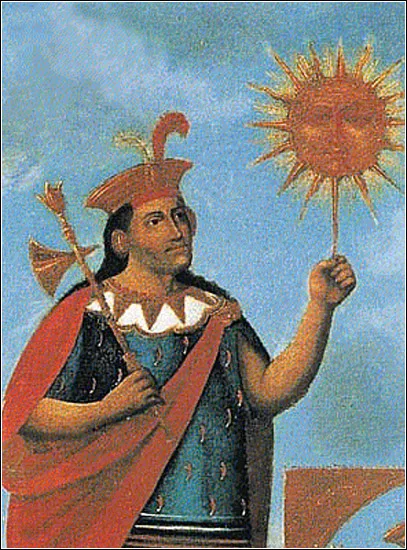
Manco Cápac
Founder of the Inca dynasty and of Cuzco, capital of Tahuantinsuyu. First Sapa Inca; head of the Chima Panaca lineage. The Pacaritambo emergence narrative (cave-emergence with three brothers and four sisters at the central window of Tambotoco) is the canonical Sarmiento/Cieza account; Garcilaso's alternative places the foundation at Lake Titicaca with descent from Inti and Mama Killa onto the floating Island of the Sun, followed by the southward migration to Cuzco. The two variants are reconciled in modern Inca-studies scholarship (Rostworowski, Julien) as competing post-Conquest framings of the same legendary founder, with Sarmiento's cave-emergence reflecting the Inca-internal Pacaritambo origin-myth and Garcilaso's Titicaca-descent reflecting the late-imperial state-cult elaboration that integrated the southern-frontier sacred lake into the dynastic narrative. Cultural ratification: the Chima Panaca corporate lineage maintained cult through the conquest; the Pacaritambo cave-site (archaeologically identified as Maukallaqta) was an active imperial-pilgrimage destination; the mascaipacha imperial fringe and Qhapaq royal title both originate with Manco Cápac and continue through every subsequent Sapa Inca to Túpac Amaru I (executed 1572). The dynastic chronology places Manco Cápac at approximately 1200 CE; this is consistent with archaeological evidence for the foundation of imperial Cuzco (Bauer 2004) but should be treated as legendary-historical rather than precisely dated.
Parentage
- paternal: Inti
Children
Powers
- teach men agriculture, law and the civilized arts
- Turns to stone
- Sinks the golden staff to find Cuzco
Epithets
- Manqu Qhapaq 'the Rich/Mighty/Royal Manco' (qhapaq 'powerful, royal, opulent') — founder of Cuzco and first Sapa Inca, son of the SunGarcilaso de la Vega, El Inca. Comentarios Reales de los Incas (1609), Book 1 (primary chronicle); Sarmiento de Gamboa, Pedro. Historia de los Incas (1572) (primary chronicle)
Relations
- spouse: Mama OclloSister-wife per imperial Inca convention; mother of Sinchi Roca.Garcilaso, Bk. I Ch. 18; Sarmiento Ch. 14 (primary)
- sibling: Ayar CachiSarmiento Ch. 11 (primary)
- sibling: Ayar Uchu
- sibling: Ayar Auca
- sibling: Mama Ocllo
- sibling: Mama Huaco
- sibling: Mama Cura
- sibling: Mama Raua
- father of: Sinchi Roca
Sources
- existence: Cieza de León, Crónica del Perú Pt. II (1553) (primary); Betanzos, Suma y Narración (1551) (primary); Sarmiento de Gamboa, Historia Índica (1572) (primary); Garcilaso de la Vega, Comentarios Reales (1609) (primary); Guaman Poma, Nueva Corónica (c. 1615) (primary)
- parentage-by-Inti: Garcilaso Bk. I Ch. 15 (primary); Sarmiento variant: parentage by Viracocha; recorded in Sarmiento Ch. 6 (secondary)
- founding-of-Cuzco: Garcilaso Bk. I Ch. 16 (primary); archaeological dating of imperial Cuzco core c. 1200-1250 CE per Bauer 2004 (archaeological)